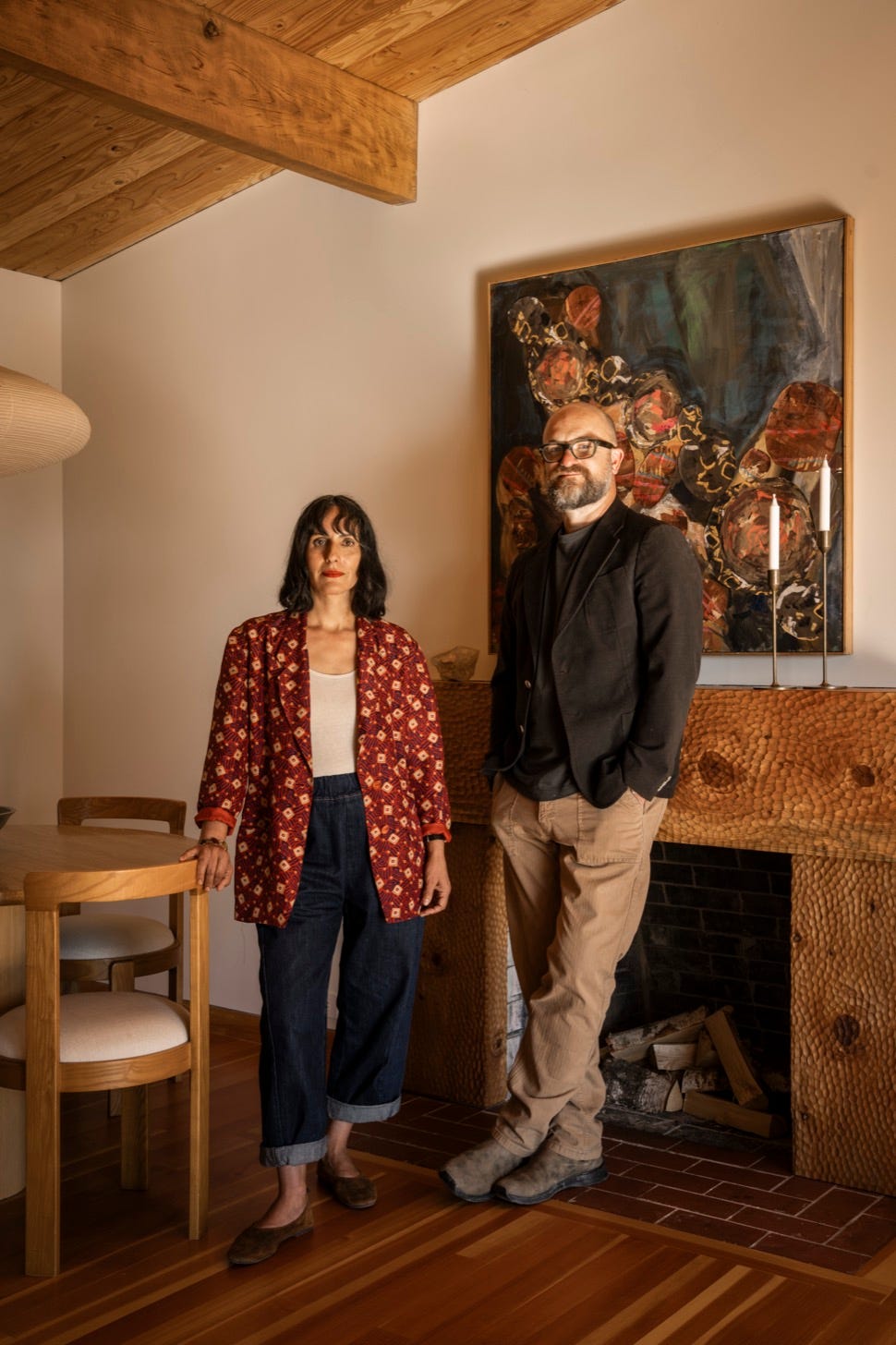
Kathryn McCullough and Andrew Bulbrook stand beside the Vince Skelly fireplace mantel in the main house. The sculptural, hand-worked surround is paired with a Douglas fir floor and Heath tile hearth. Noguchi lantern lighting, visible at left, casts the warm glow Kathryn looks for in every space she designs.
There’s a moment when you arrive at the Rome Drive property that Kathryn McCullough describes as a deep exhale. You’re standing on a double lot at the top of Mount Washington, the San Gabriel mountains behind you, the glitter of the Pacific visible to the west on a clear day. The city is right there — and somehow, also very far away.
“Seeing the mountains on one side and the city and sea view on the other,” Kathryn says. “There’s something about having a wide view that can give one a feeling of a bigger perspective. I think a lot of daily stresses melt away when you can zoom out.”
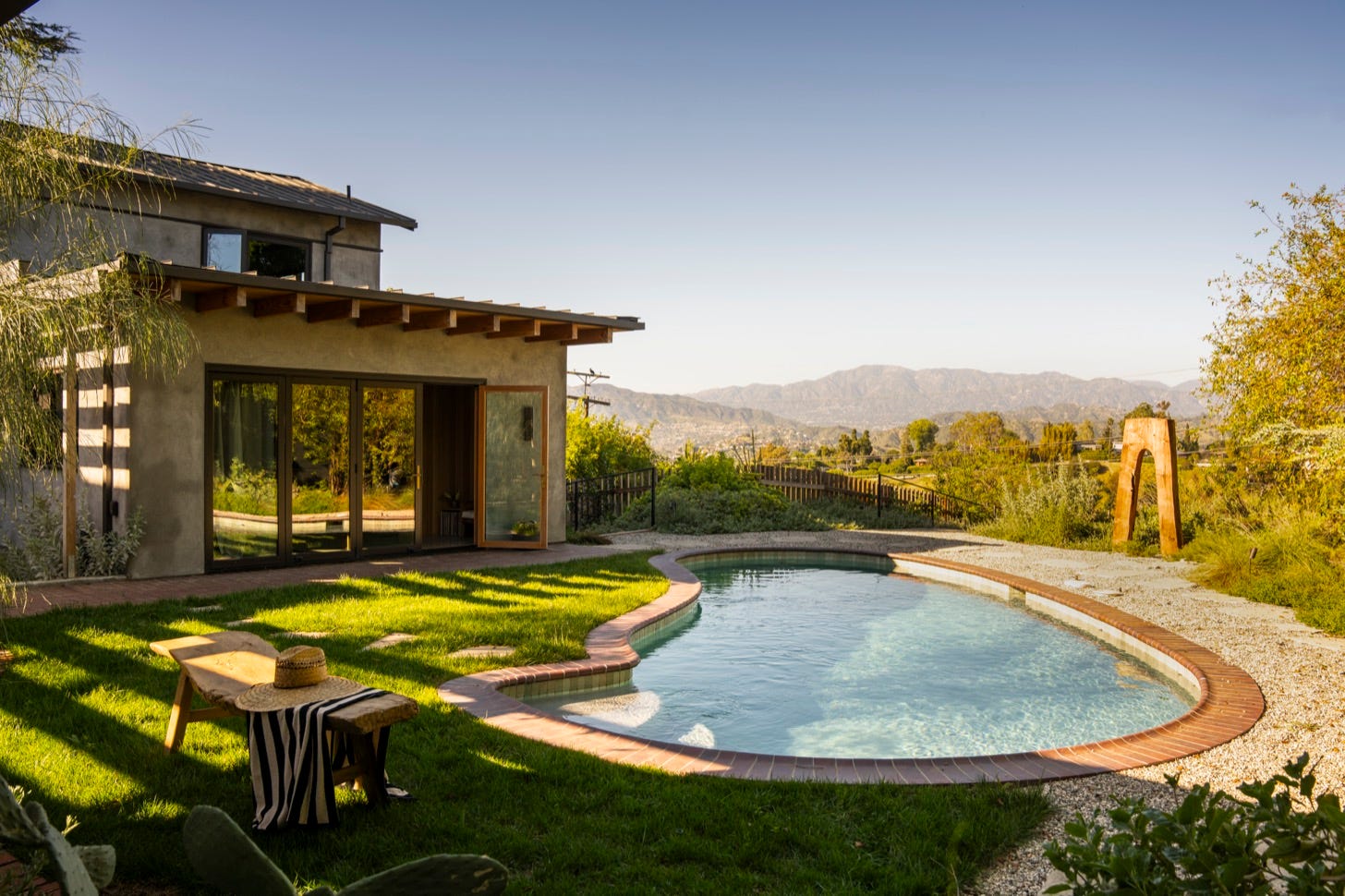
The barn, pool house, and pool at golden hour, the San Gabriel Mountains visible in the distance. The property is primarily planted with California natives, designed by Terremoto.
Kathryn has lived down the street from the Rome property for years. She knows this hill the way you only can when you’ve walked it at night, learned the owls by sound, watched the seasons move through the canyon. When the double lot came on the market — rundown, overgrown, but unmistakably magnetic — she and her partner Andrew Bulbrook recognized something in it immediately.
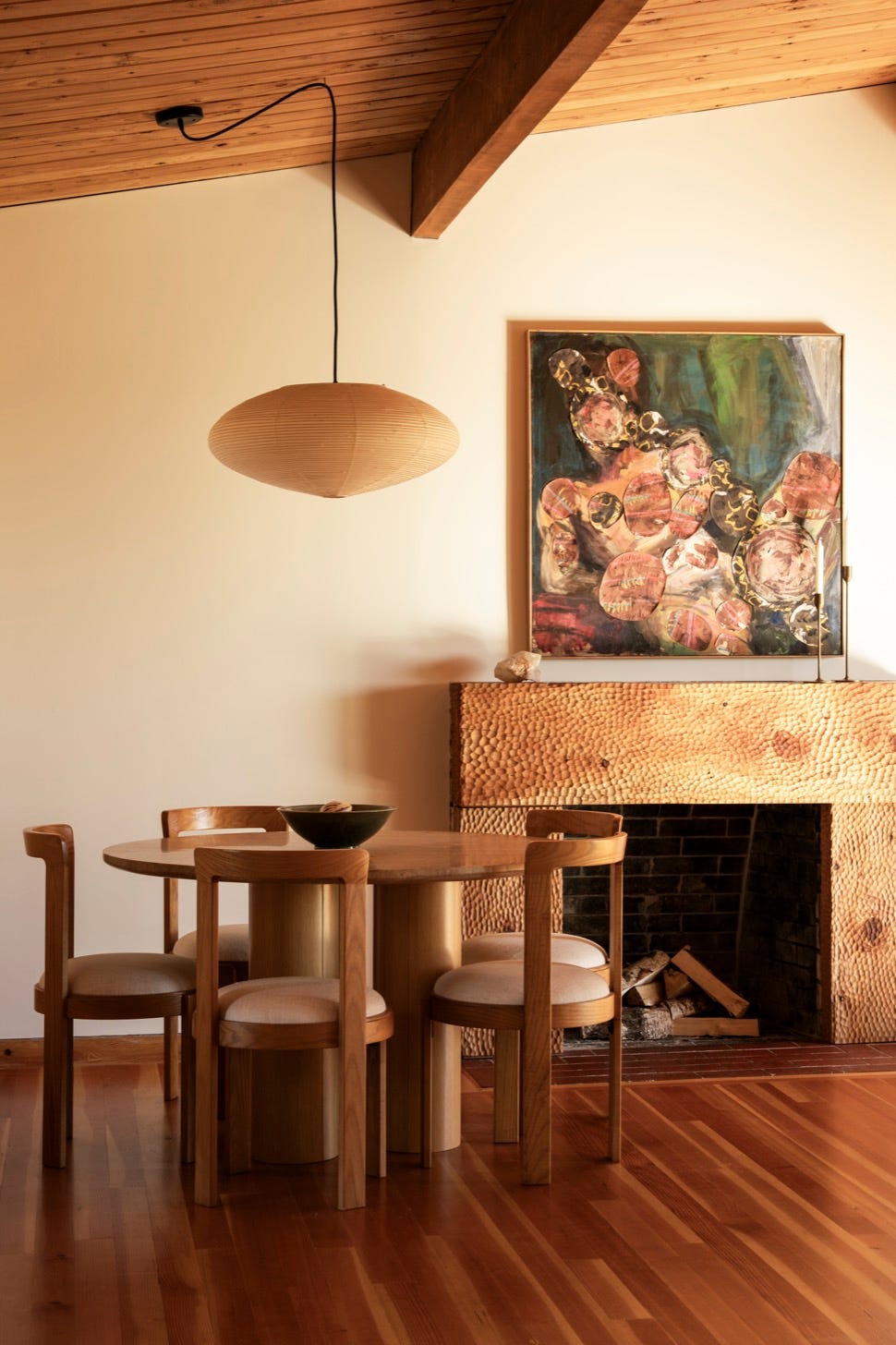
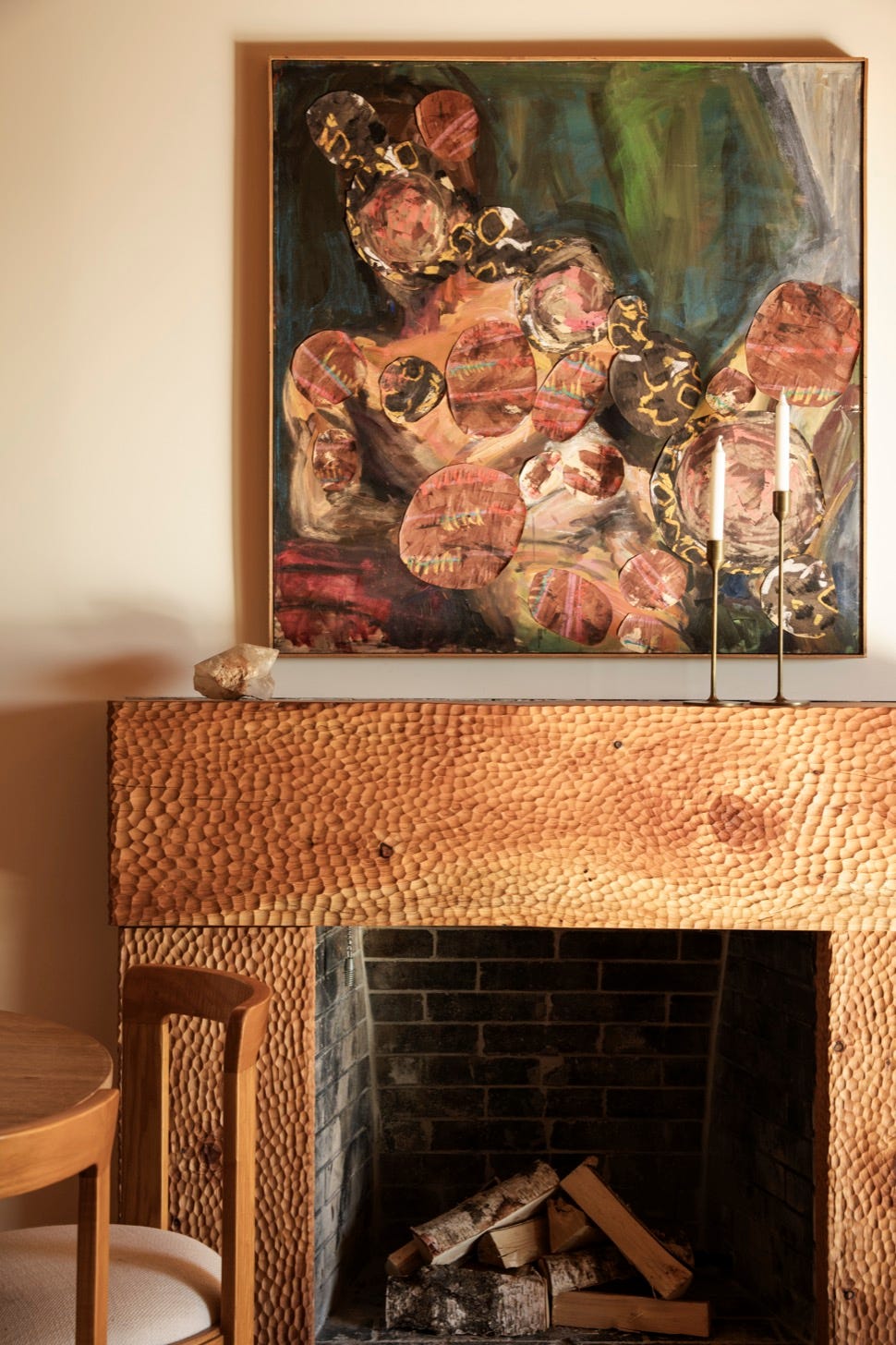
A Vince Skelly mantel anchors the dining room of the main house; its hand-carved, pebbled surface catching the light. A Noguchi pendant floats above a round Douglas fir dining table.
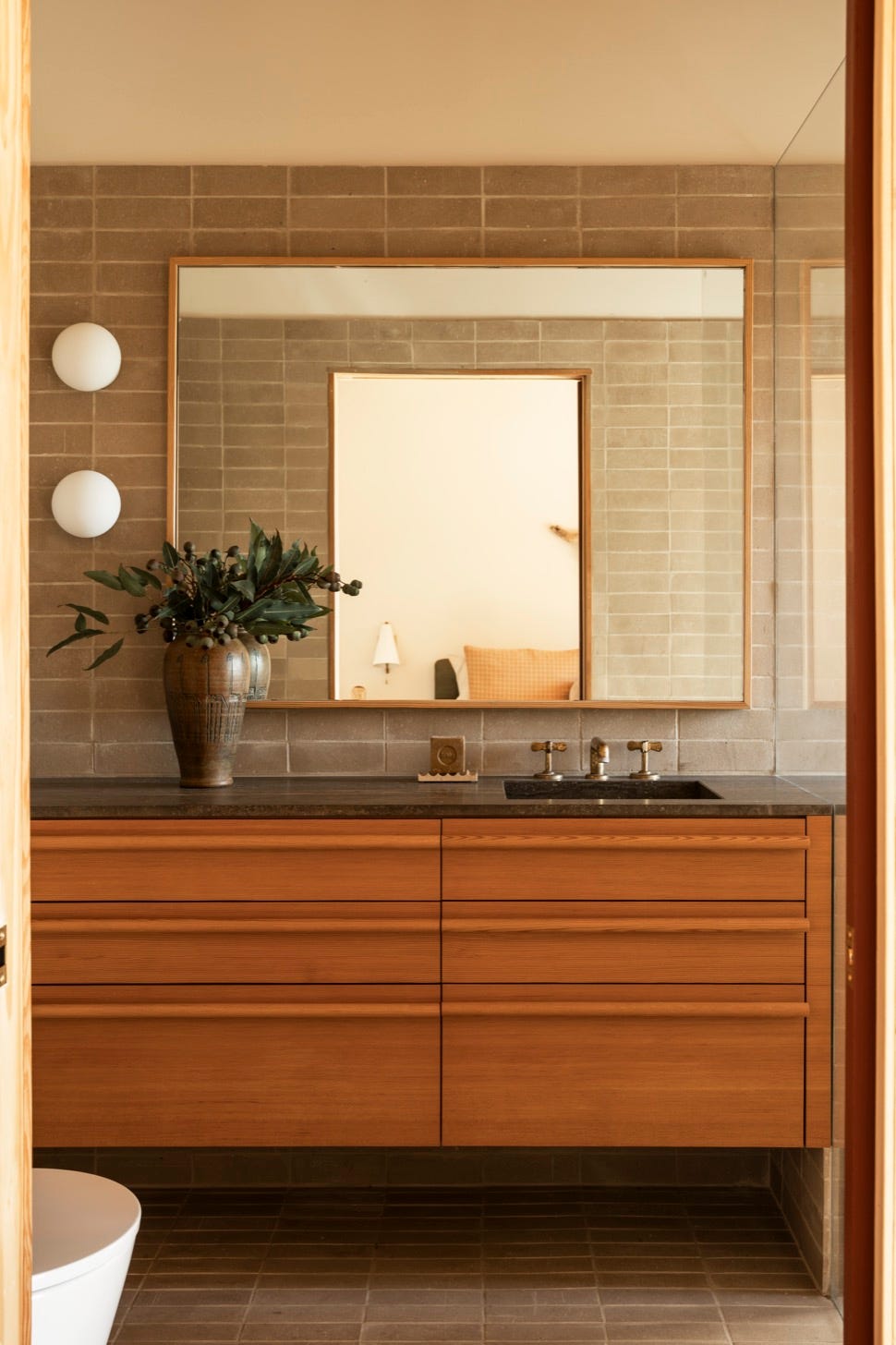
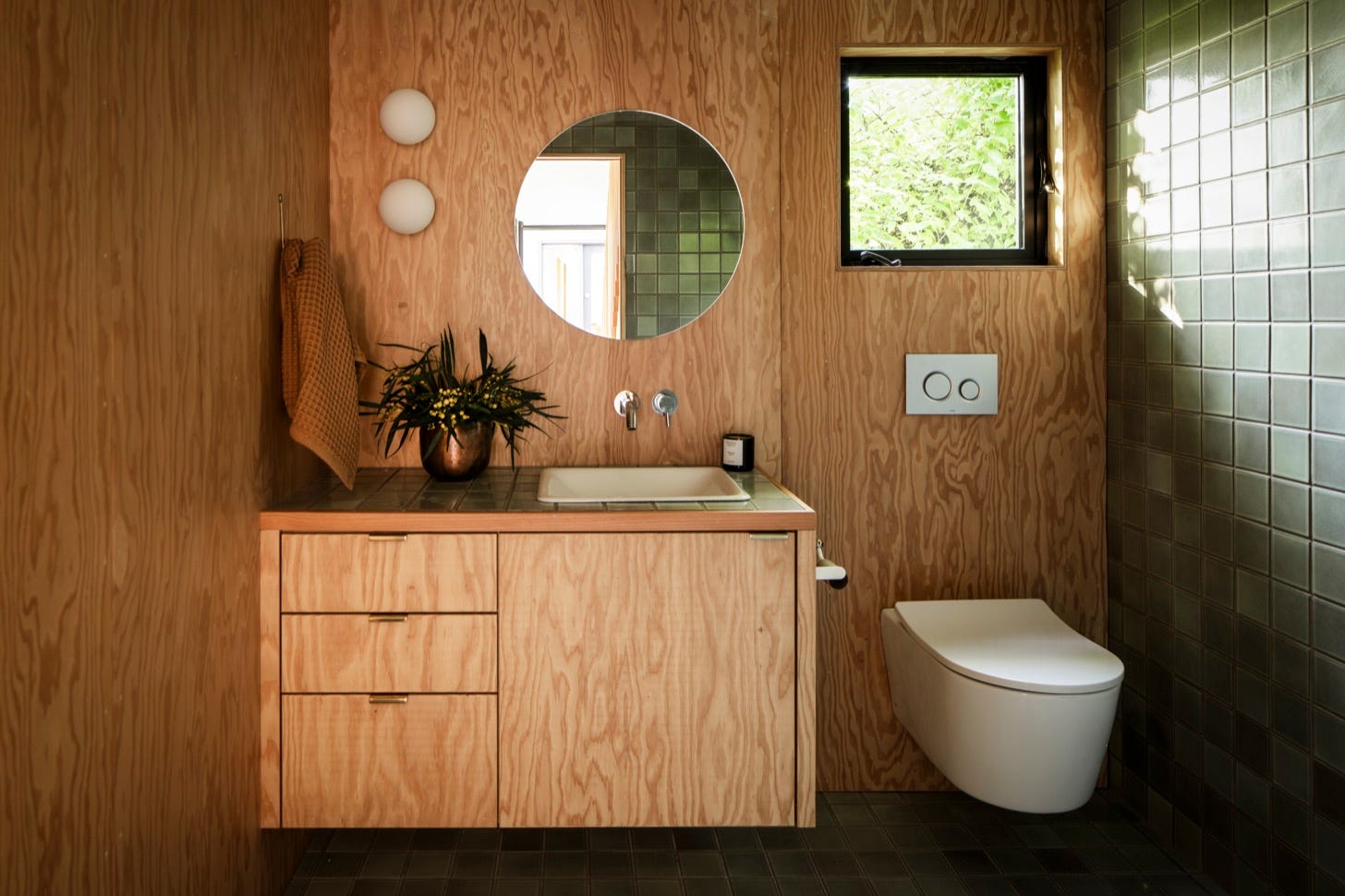
A floating Douglas fir vanity with honed stone countertop in one of the property's four bathrooms. Handmade Zia tile lines the walls. Each bathroom on the property features a different tile, all handmade.
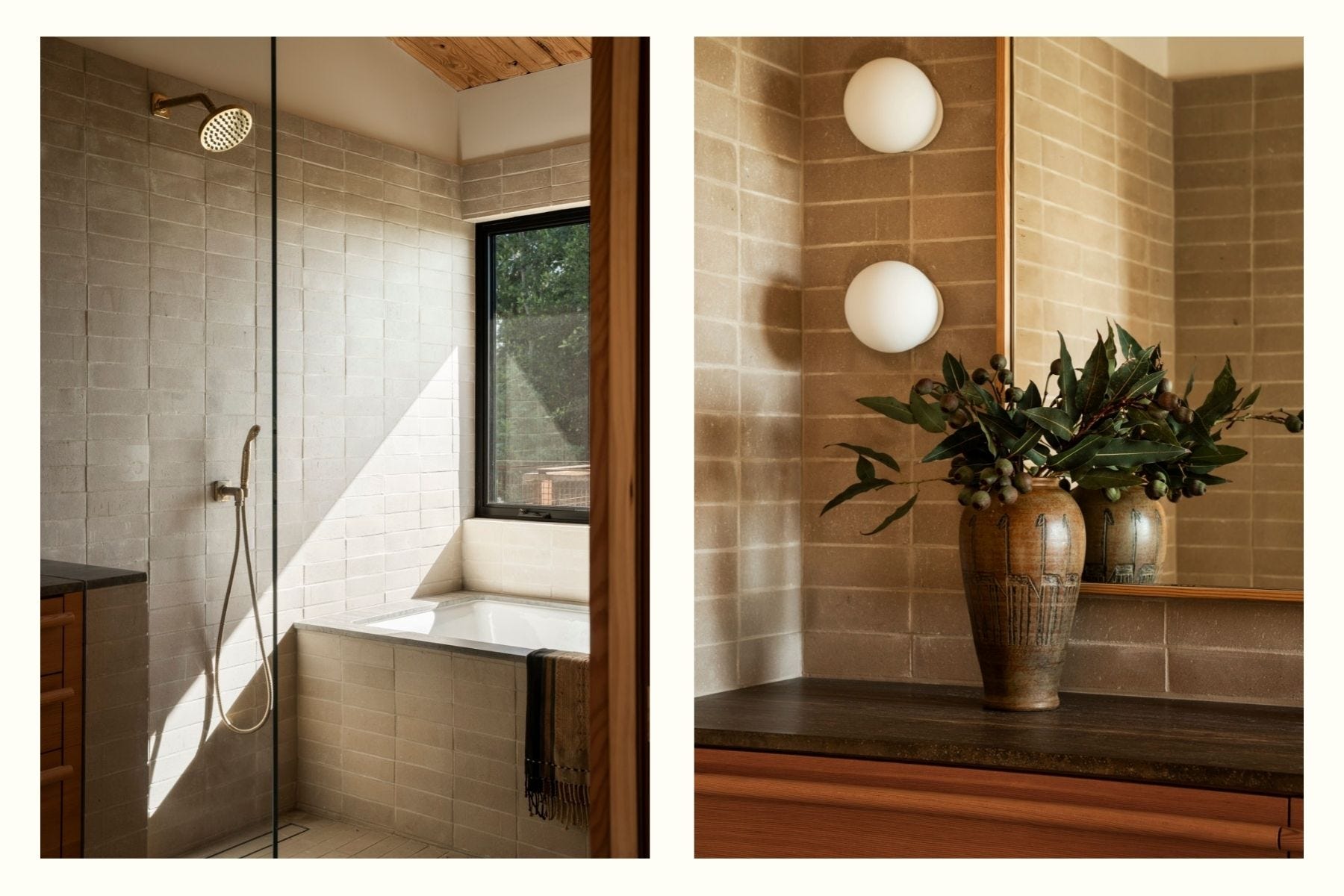
Left: Brass fixtures and a soaking tub are positioned to catch the hillside light in the primary home. Right: The Artemis globe sconces repeat throughout the property.
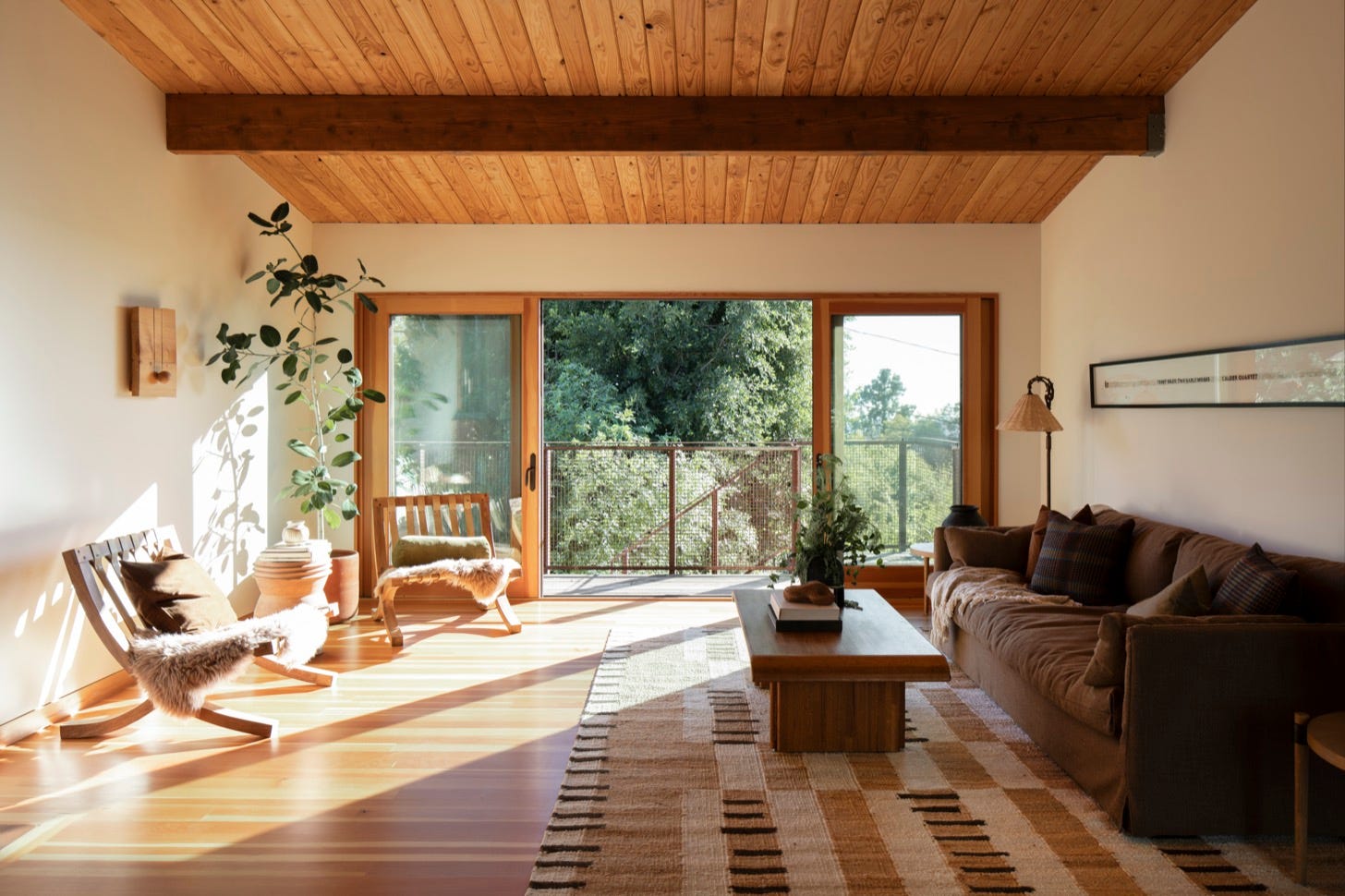
The living room of the primary home, flooded with morning light. The existing ceiling was preserved during renovation. Keeping original material out of the landfill is a baseline principle of Kathryn's practice.
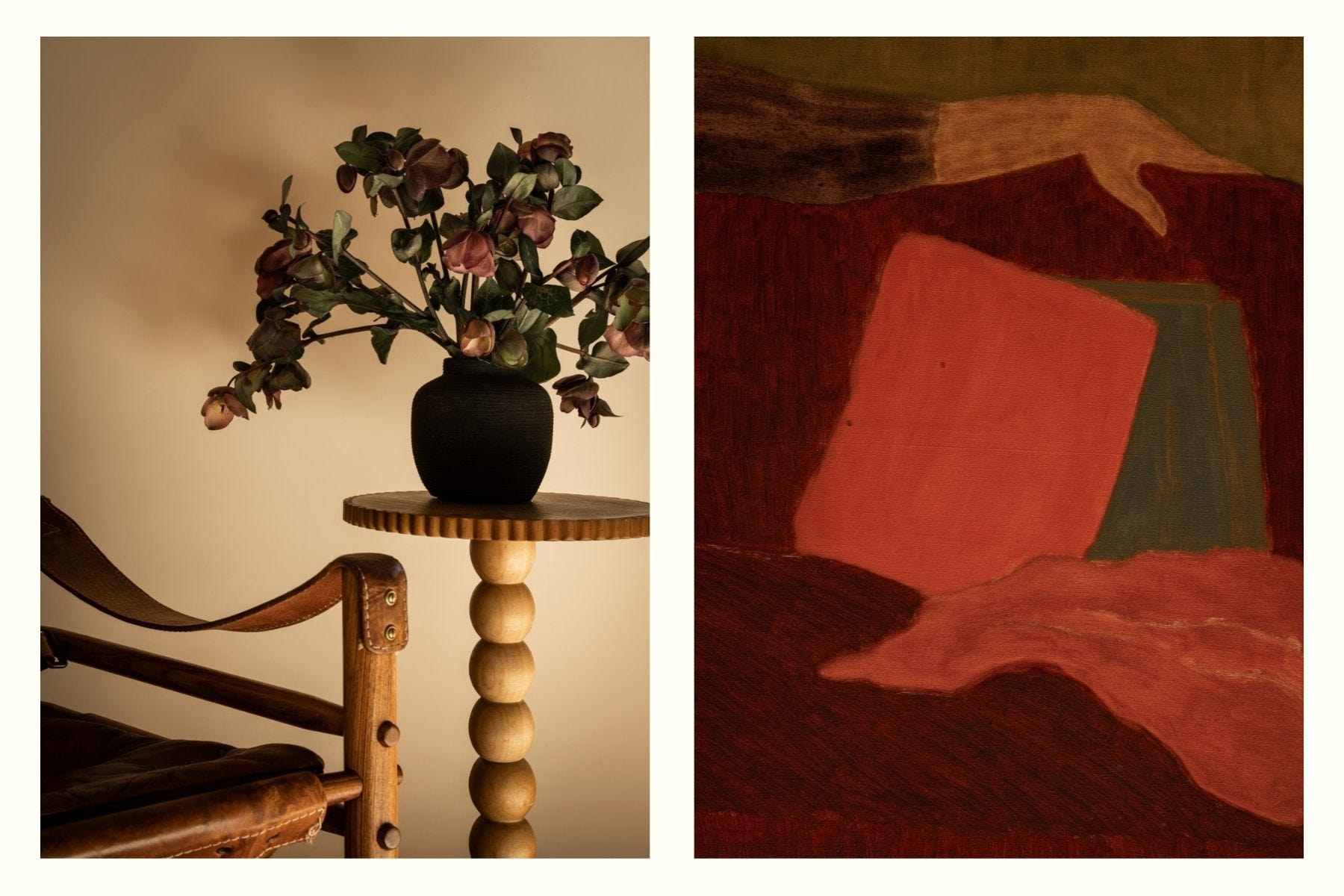
Left: A bobbin side table and dark ceramic vessel beside a leather safari chair in the primary bedroom. Right: A close detail of one of the paintings staged throughout the property, the deep reds pulling the warmth of the Douglas fir floors into the walls.
The property is home to four separate living spaces: a mid-century primary home, a barn, a pool house, and a two-story ADU — each with its own character, each in conversation with the others.
Kathryn’s design intention was never to homogenize them, but to create a kind of material dialogue across the site. The primary thread running through all four spaces is Douglas fir, used for floors, windows, doors, and cabinetry throughout and appearing in slightly different iterations in each structure. Handmade tile anchors each bathroom. Custom steel details move consistently from interior to exterior.
The result is a compound that can function as four independent homes or as one grand home, with the courtyard serving as the connective tissue — a primary gathering spot for a community, or a private garden for one.
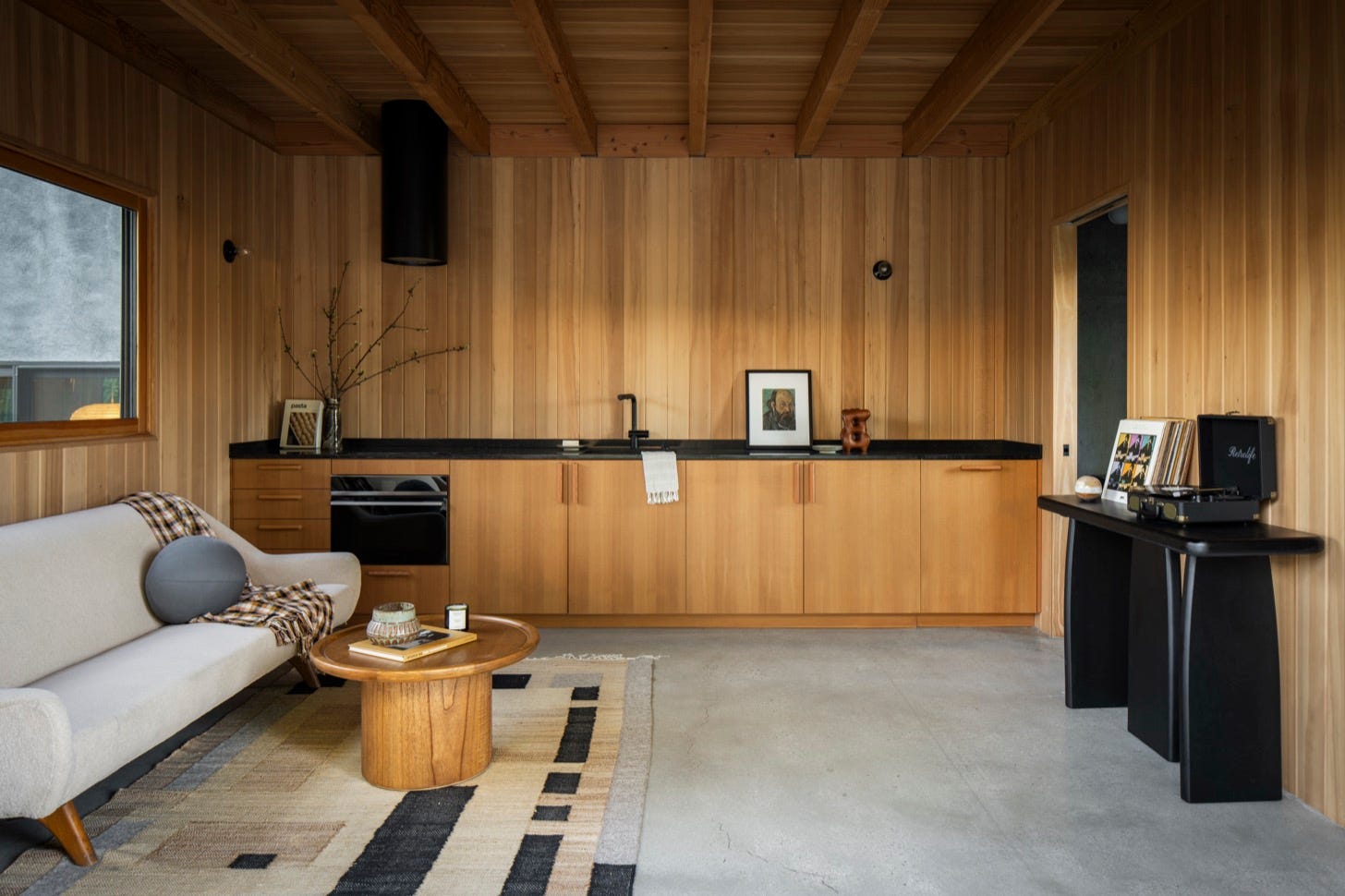
The pool house features Douglas fir tongue-and-groove walls and ceiling, and concrete floors. The whole room is a single material idea executed completely. Ravenhill Studio sconces, honed black stone countertops, and Douglas fir cabinetry carry the compound's material language into its most intimate structure.
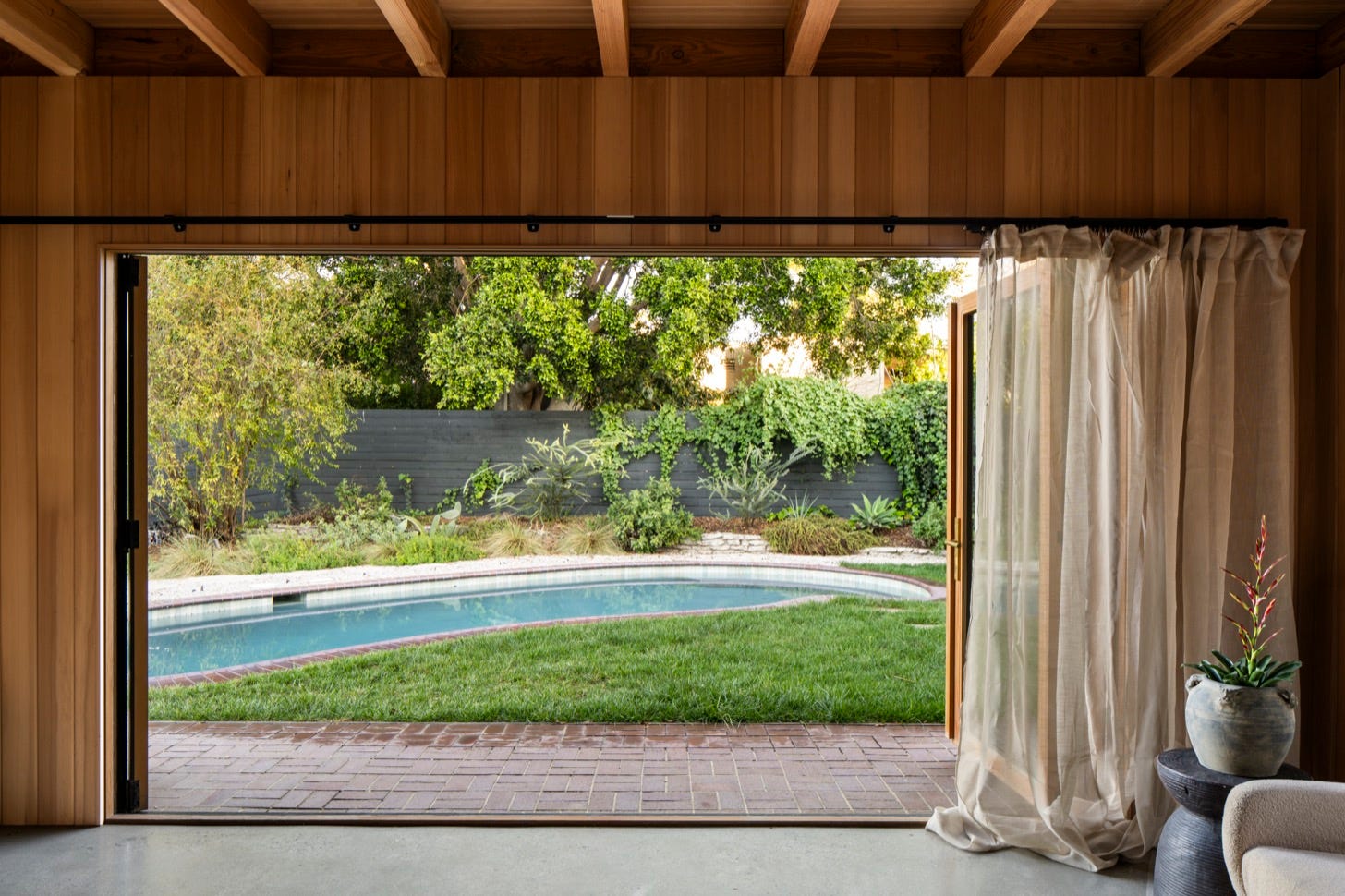
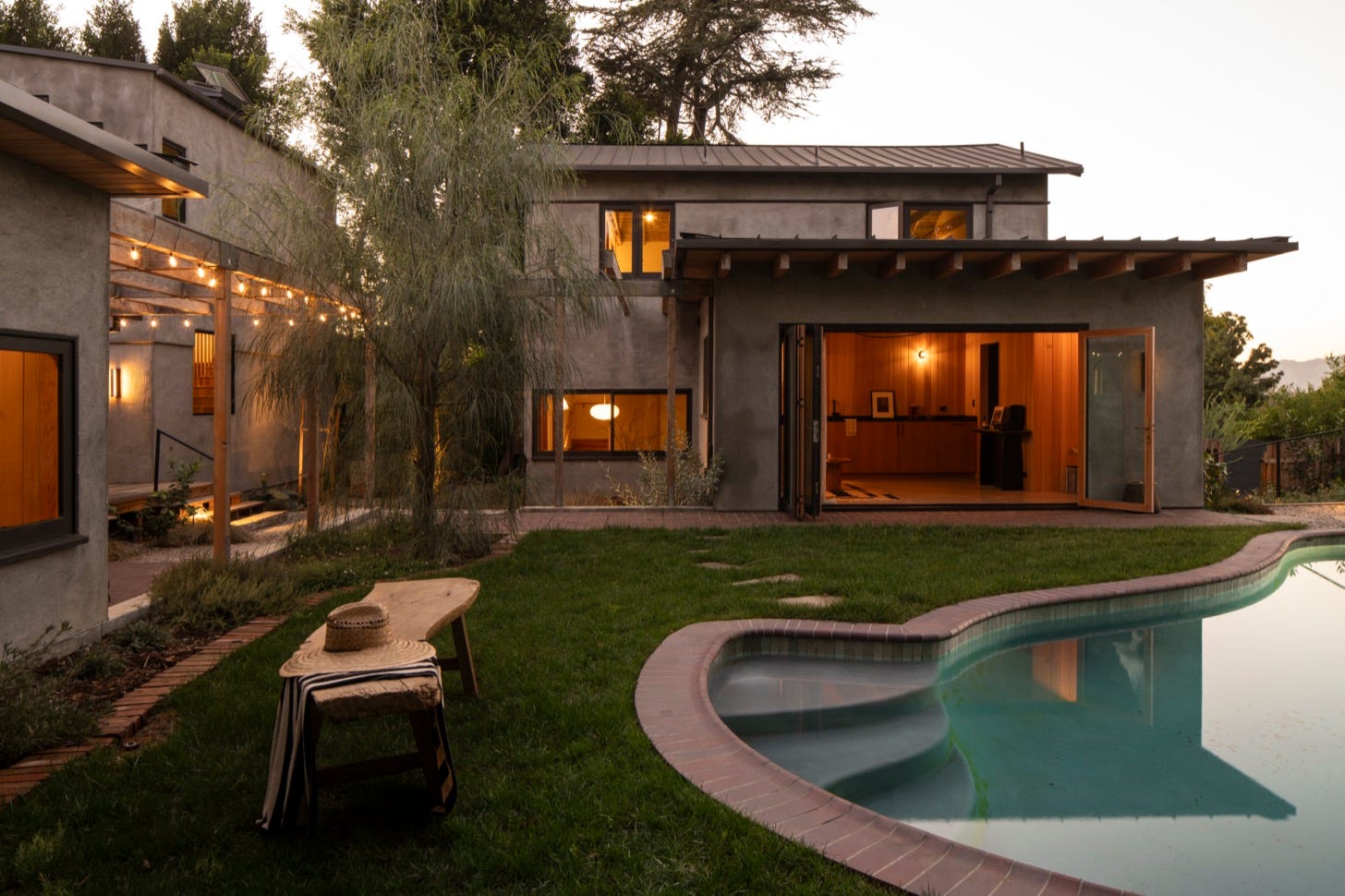
The pool house opens fully to the garden through a bi-fold TM Cobb door. Linen curtains catch the breeze. The boundary between inside and outside dissolves entirely.
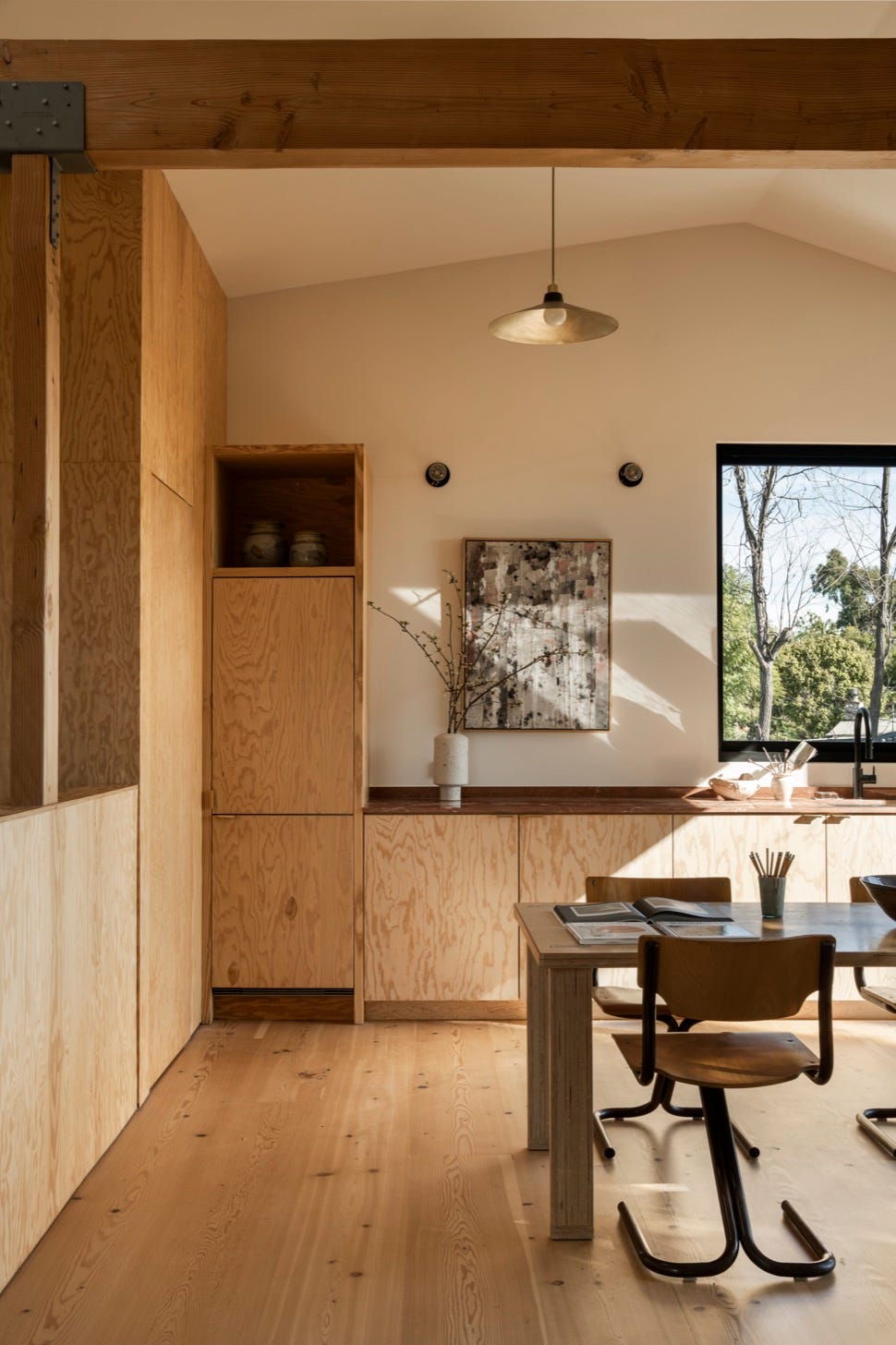
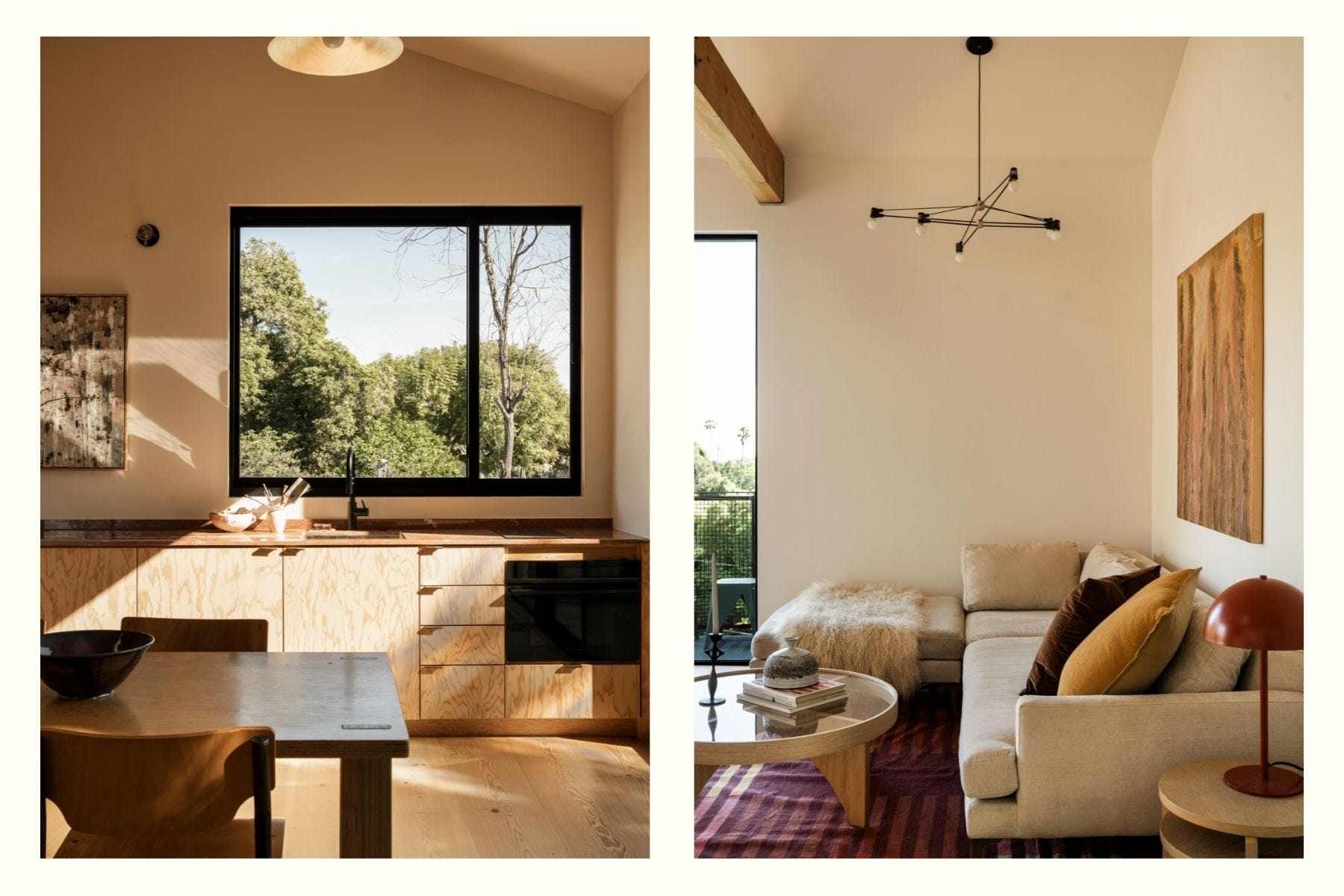
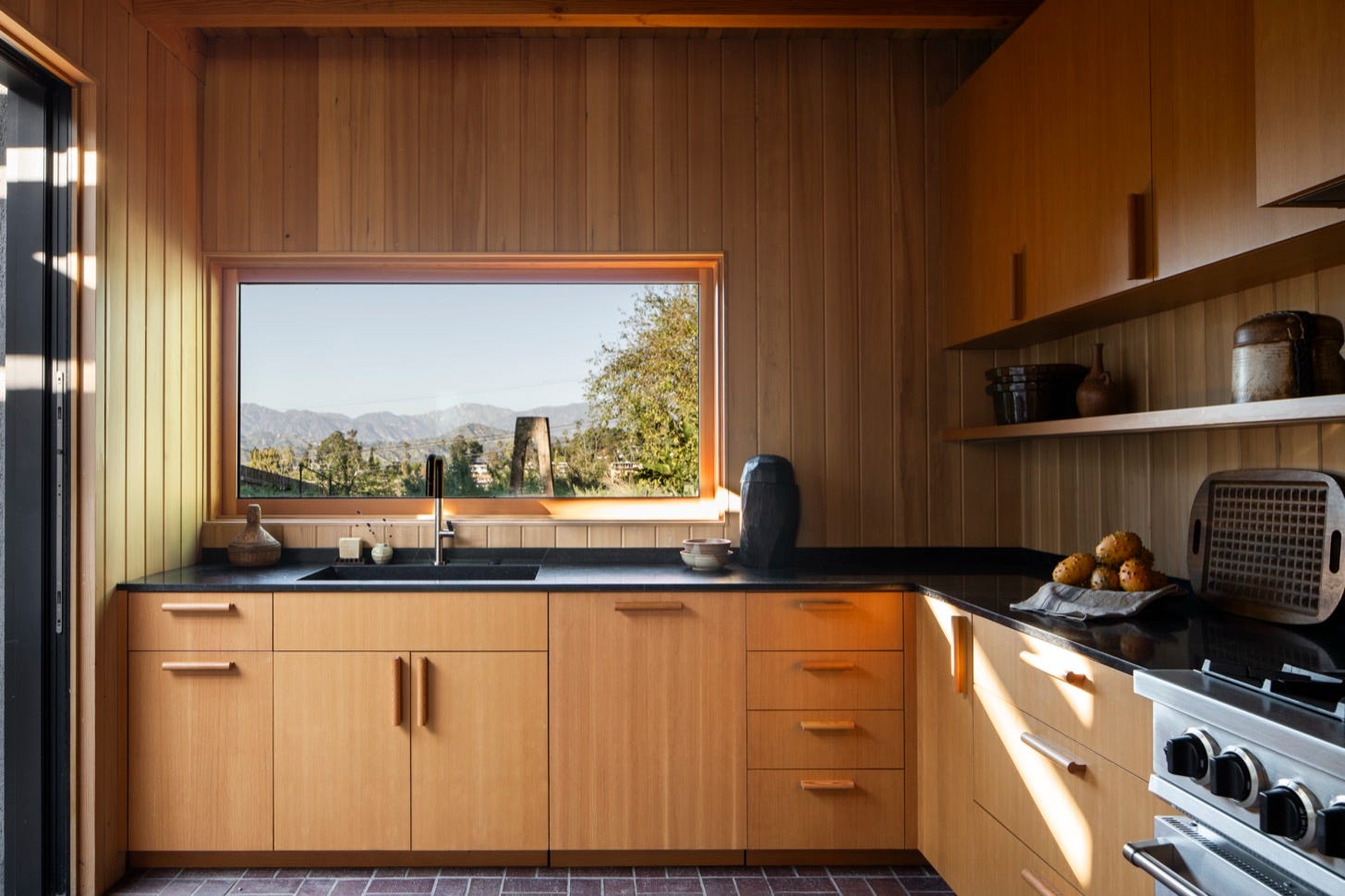
The second-story kitchen of the ADU opens to sweeping views of Los Angeles through a Marvin window. Douglas fir plywood cabinetry wraps the walls floor to ceiling. Pine floors, exposed Douglas fir beams with custom steel connectors, and a Ravenhill Studio pendant ground the space. The vaulted ceiling amplifies the sense of light and air that comes with being at the top of the hill.
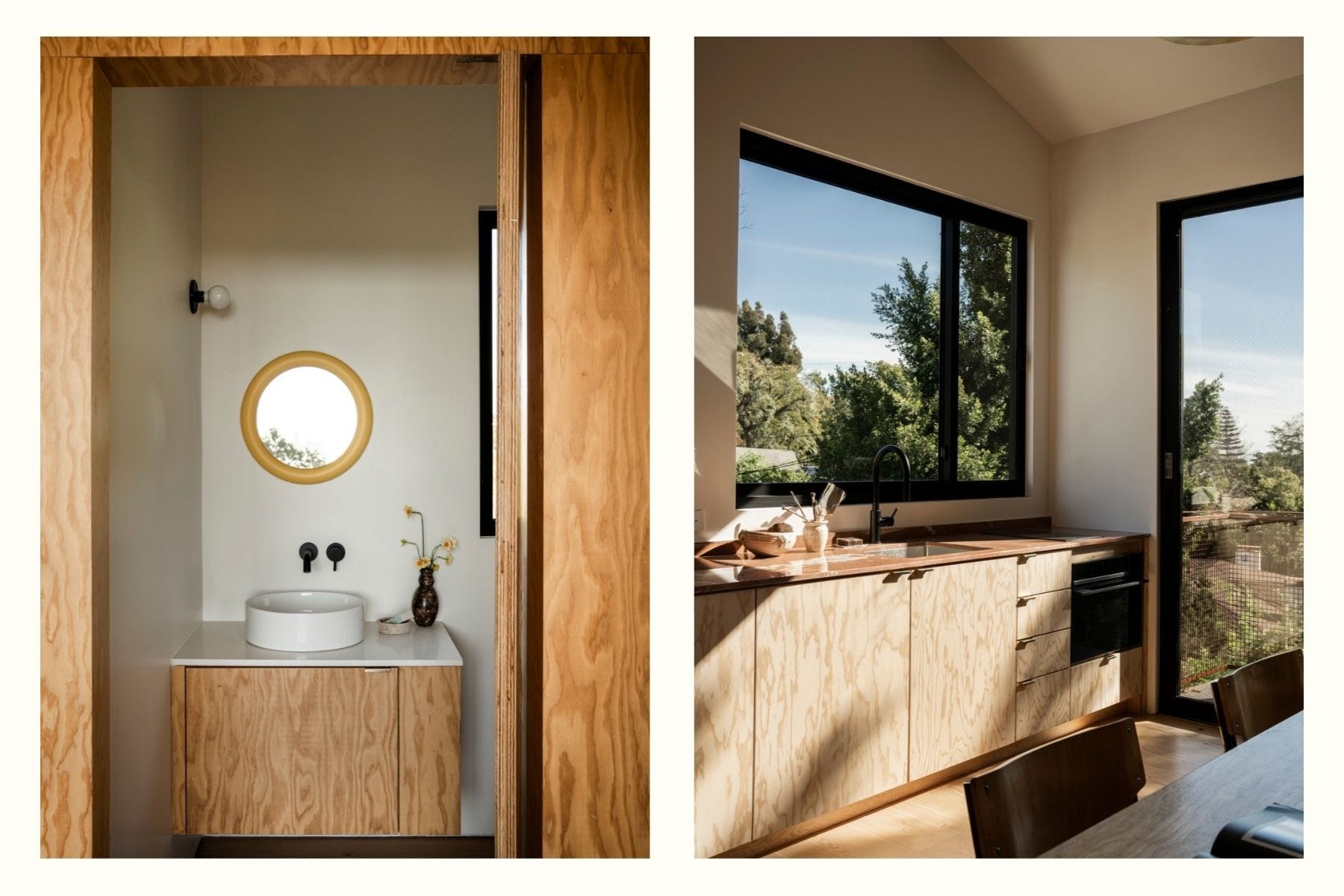
Left: A porthole mirror and vessel sink tucked into a Douglas fir plywood nook. Right: The ADU kitchen sink window, treetops spilling into frame.
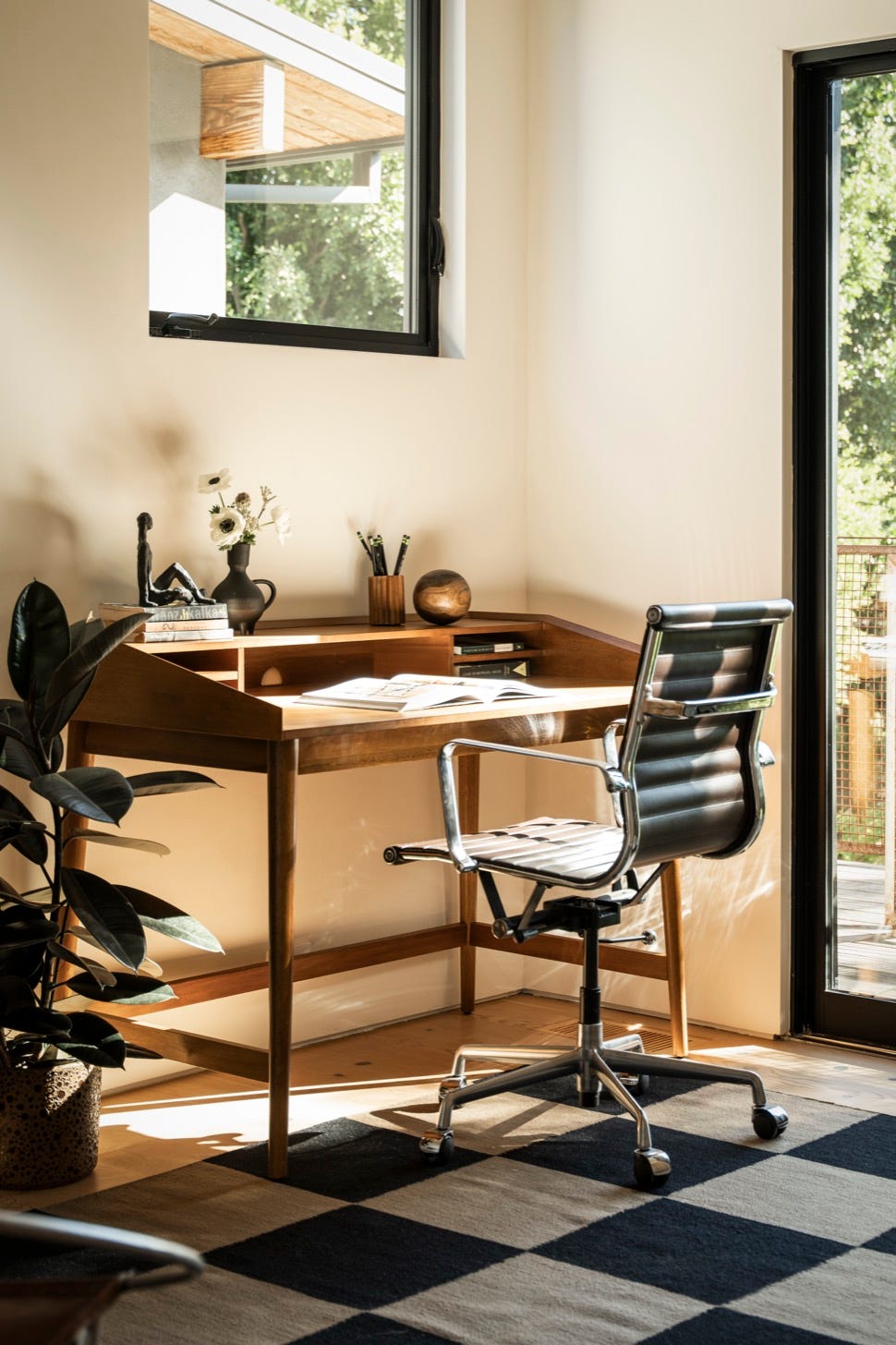
A wood secretary desk and Eames Aluminum Group chair tucked into a corner in the downstairs of the ADU, the kind of desk you actually want to sit at.
Douglas fir plywood walls, a floating vanity with brass hardware, and handmade tile in deep sage green. Every bathroom on this property has its own distinct personality, yet they are cohesive as a set.
The outdoor spaces were never an afterthought. Landscape studio Terremoto — who had worked alongside Kathryn and Linda Taalman Architecture on her own Mount Washington home — came into the design process in the earliest meetings.
The site is primarily planted with natives. Concrete broken up during construction was reset as pavers, built into garden walls, and shaped into an amphitheater at the back of the property. Nothing left the lot that didn’t have to.
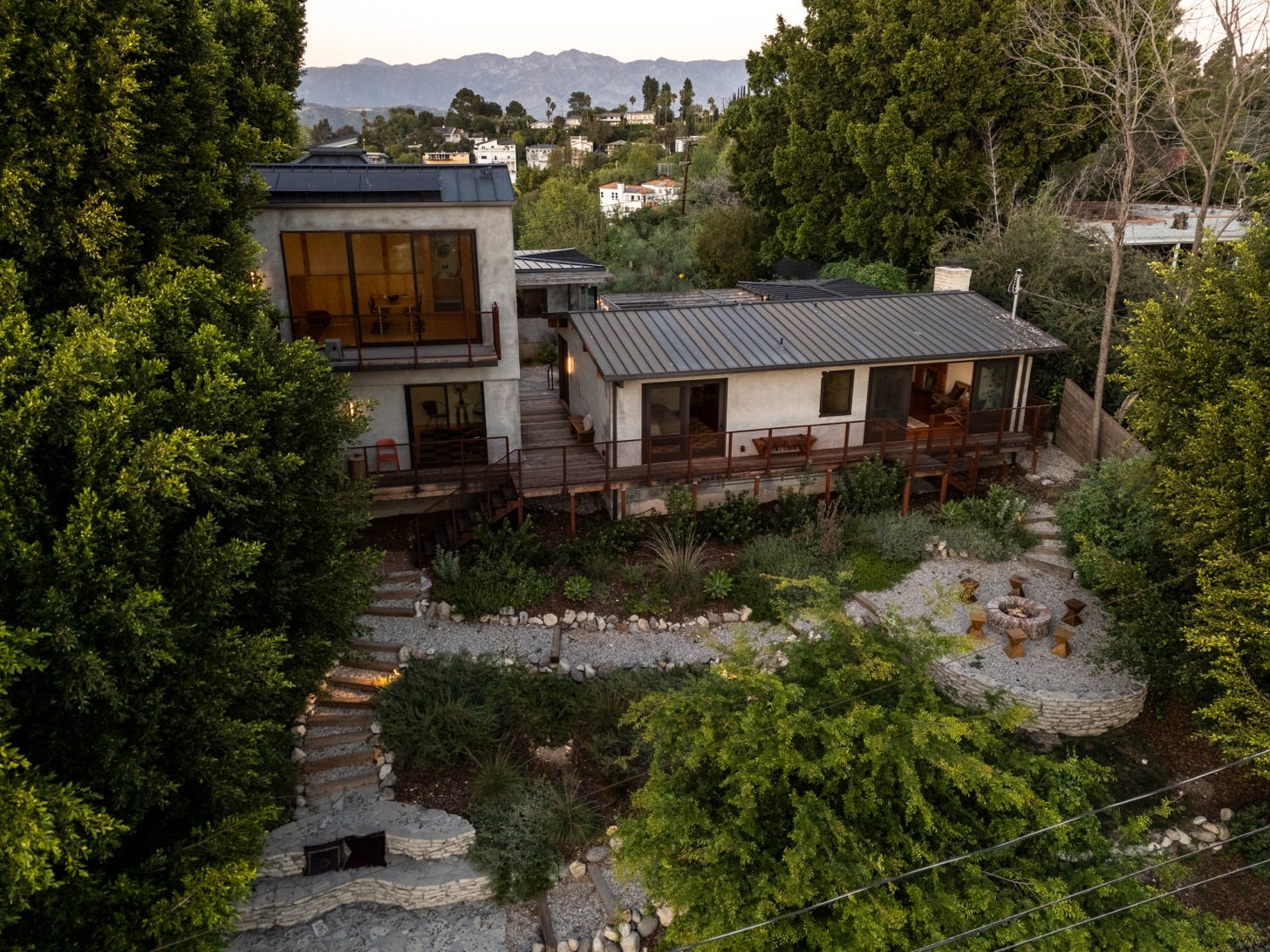
An aerial view of the Rome property compound showing the relationship between the ADU (left, two-story) and the mid-century house (single-story, right). The courtyard functions as the hub between all four living spaces. Stone pathways, the stone amphitheater, and Terremoto's native planting scheme connect the structures across the lot.
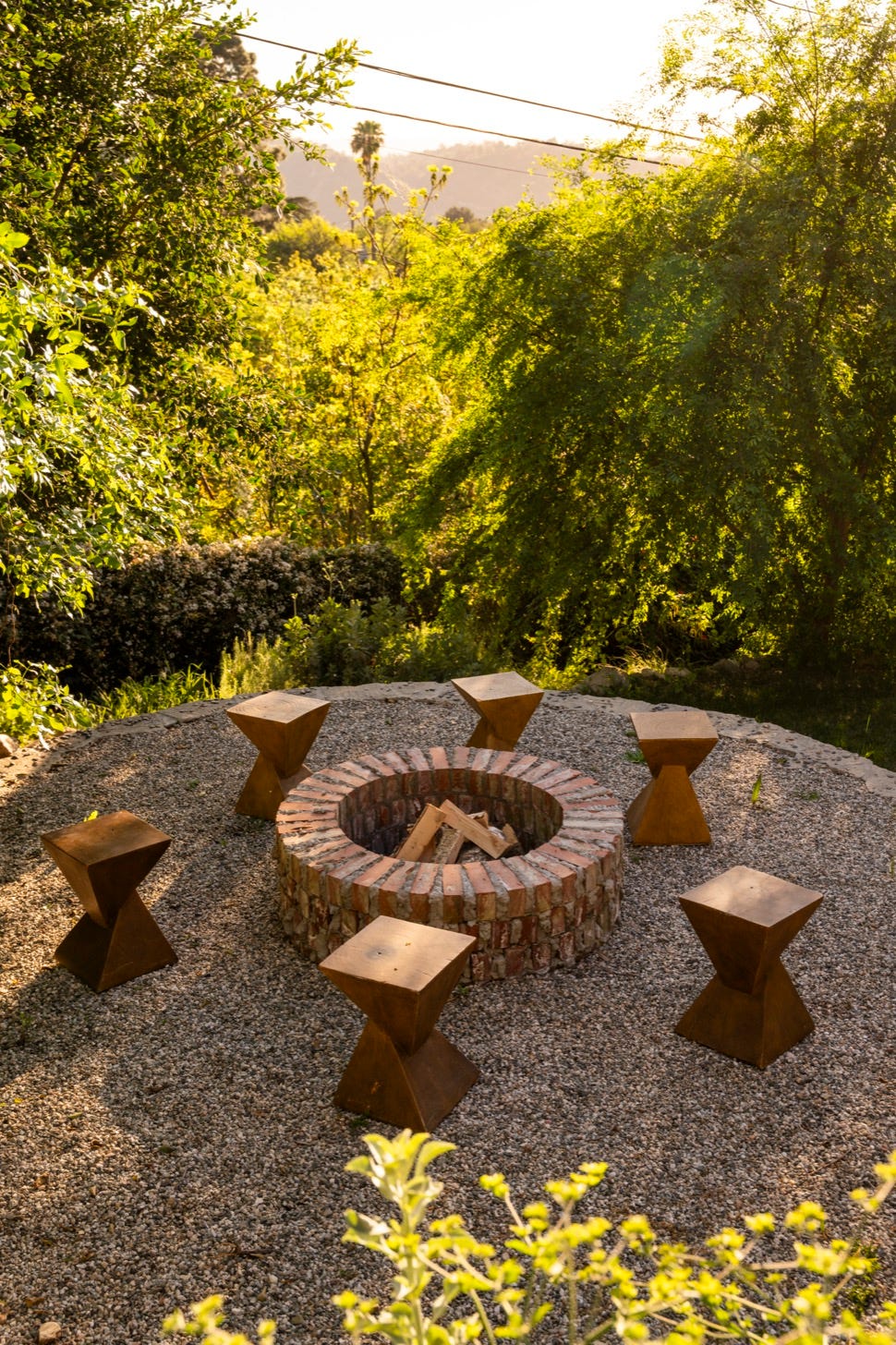
A closer view of the stone amphitheater, built from concrete salvaged during construction. Hourglass stools ring a brick fire pit at the back of the property to create the kind of place where people stay later than they planned.
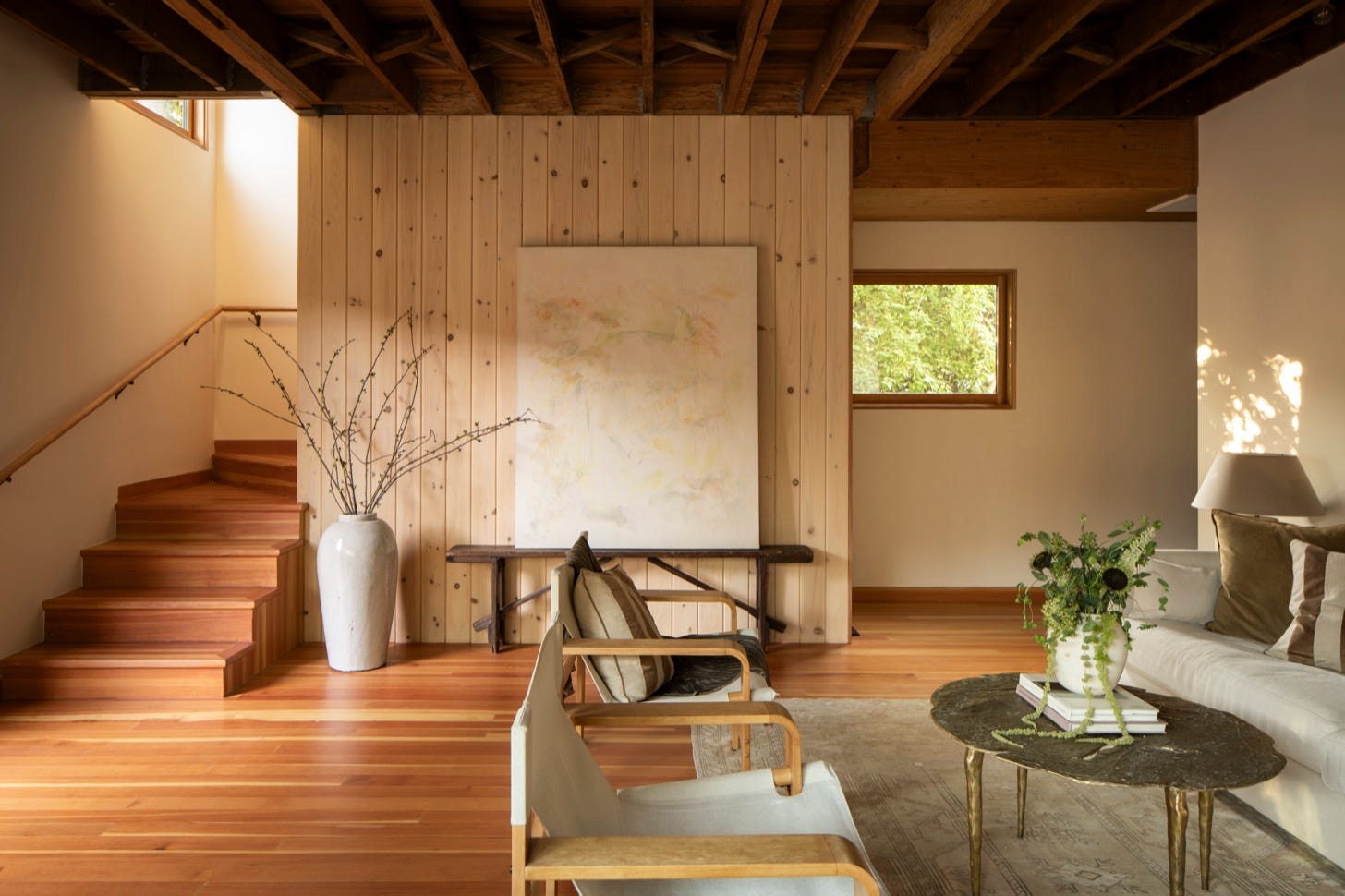
The barn's main living space features pine tongue & groove wall paneling, Douglas fir floors, and the original 1940s exposed ceiling joists. A large canvas leans against the wood rather than hanging from it.
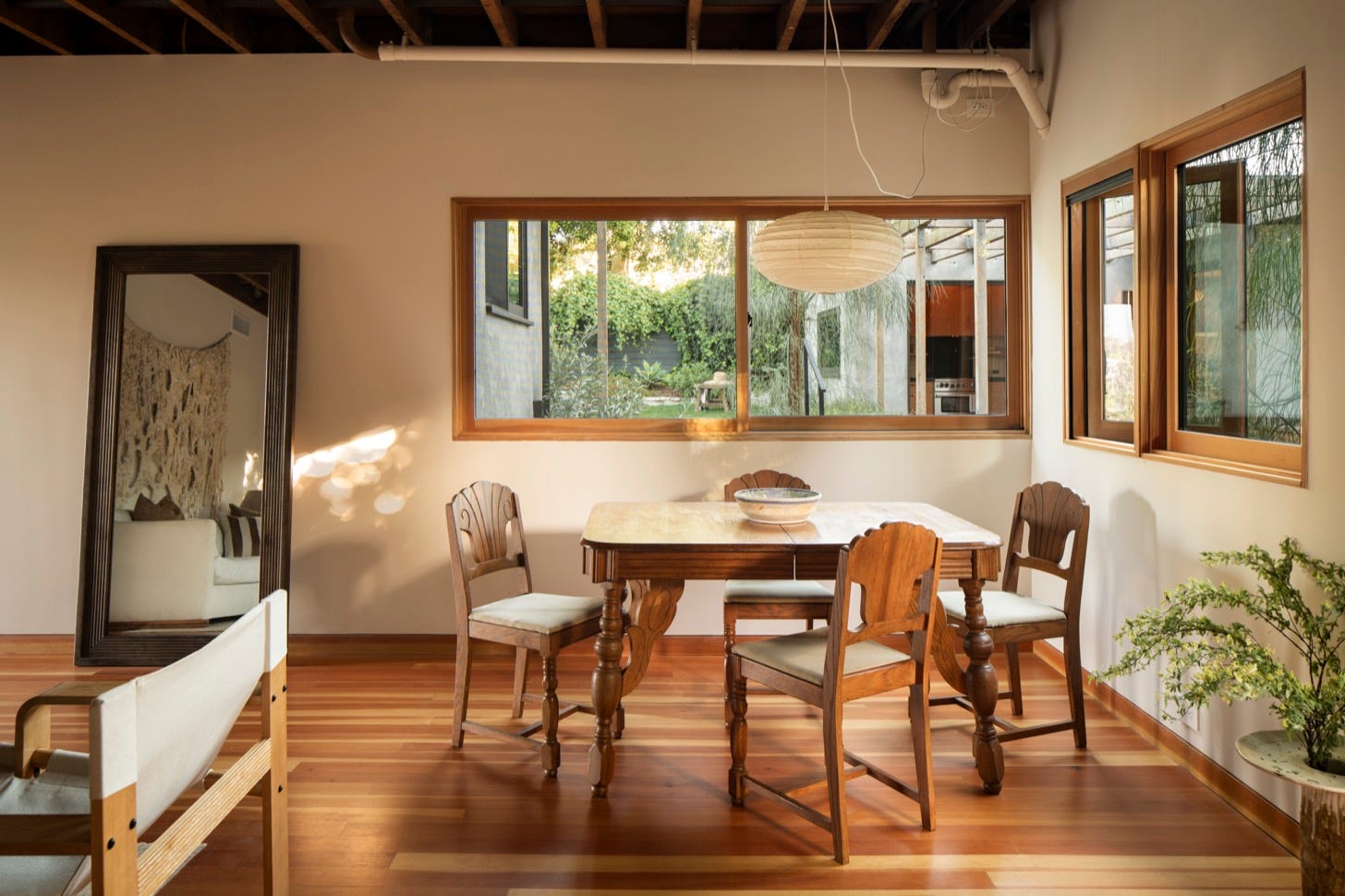
The dining room of the barn, original Douglas fir floors glowing beneath a Noguchi pendant. Picture windows frame the courtyard and the primary home beyond.
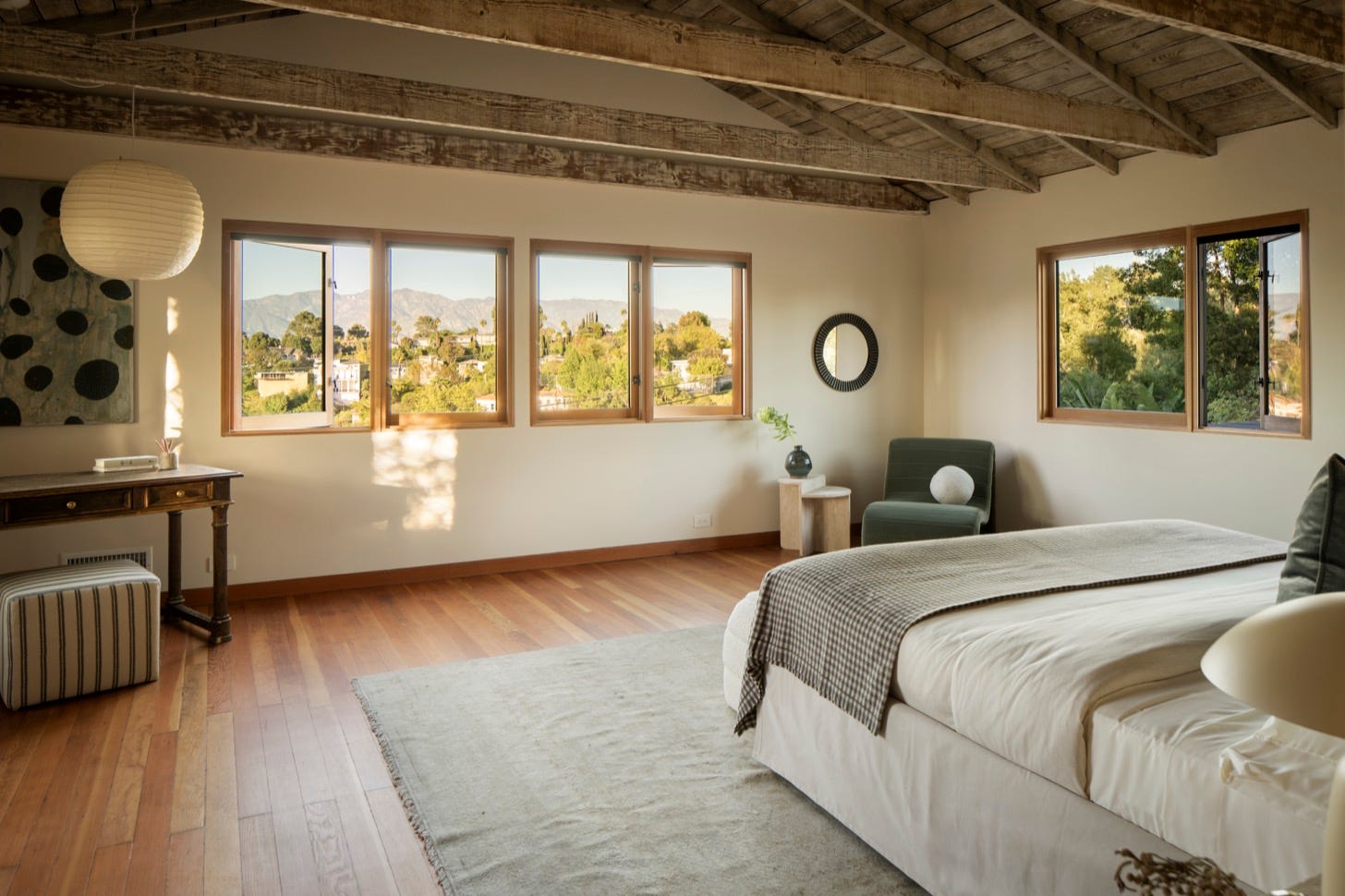
The barn's primary bedroom, with original weathered ceiling beams preserved from the existing 1940s structure. Five windows line the wall, the San Gabriel Mountains filling the frame. A Noguchi lantern, Douglas fir floors, and space enough to breathe.
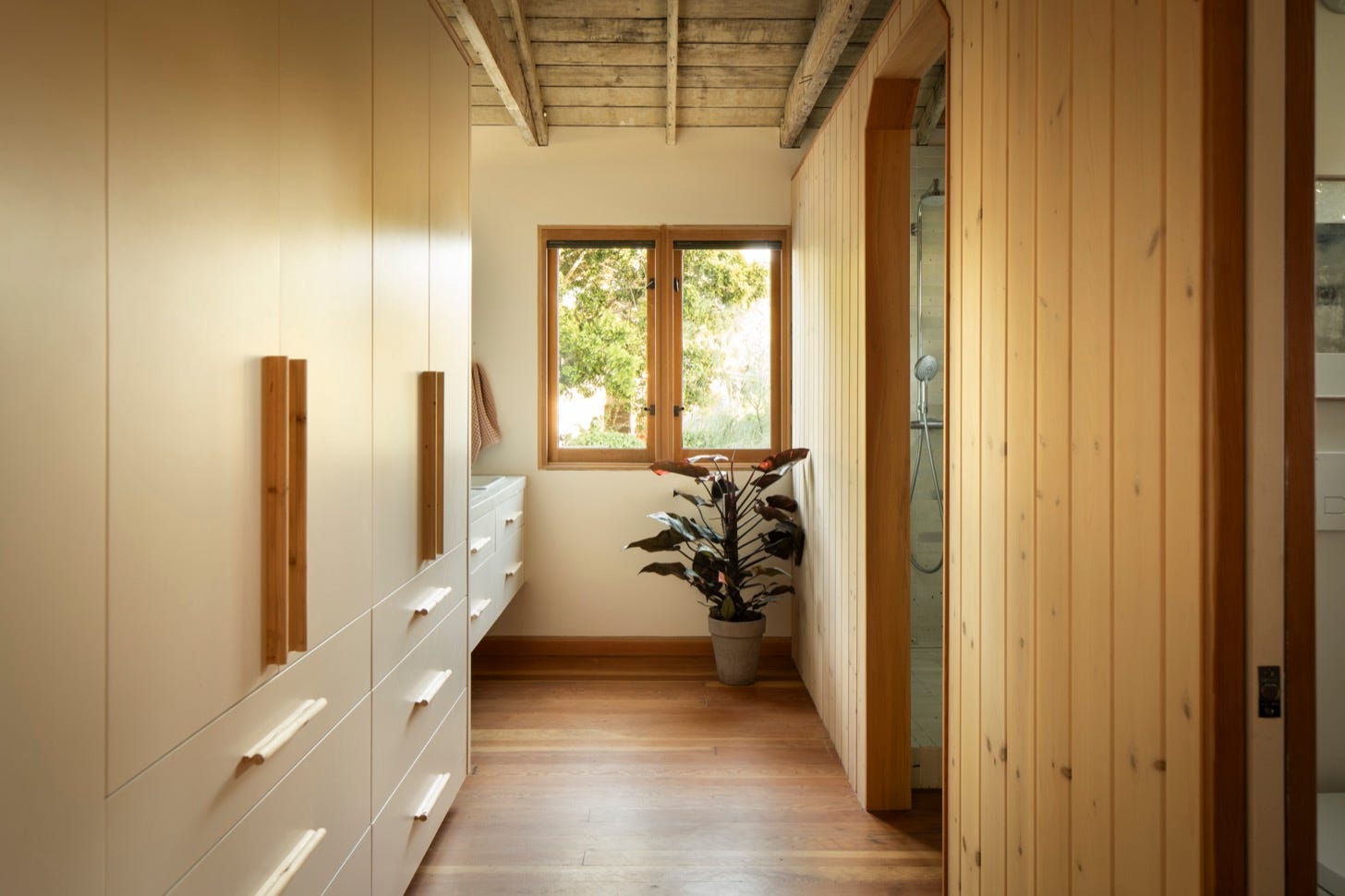
The dressing corridor leading to the barn’s primary bath has built-in cabinetry with Douglas fir pulls, and tongue-and-groove paneling on the bathroom entry wall.
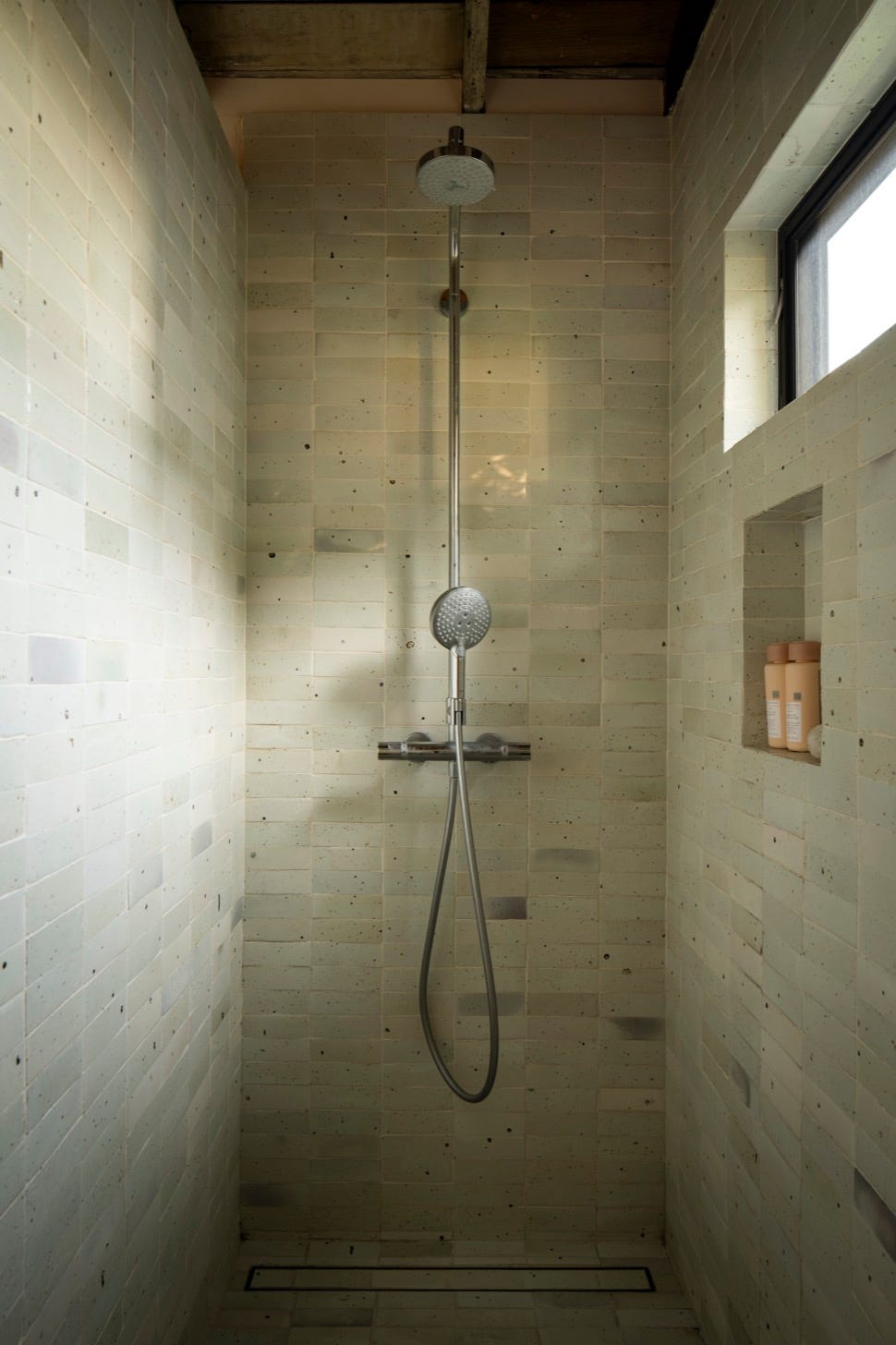
Floor-to-ceiling handmade tile in the barn's primary shower, light filtering through a high Marvin window. Each bathroom on the property uses a different tile — all handmade, all distinct.
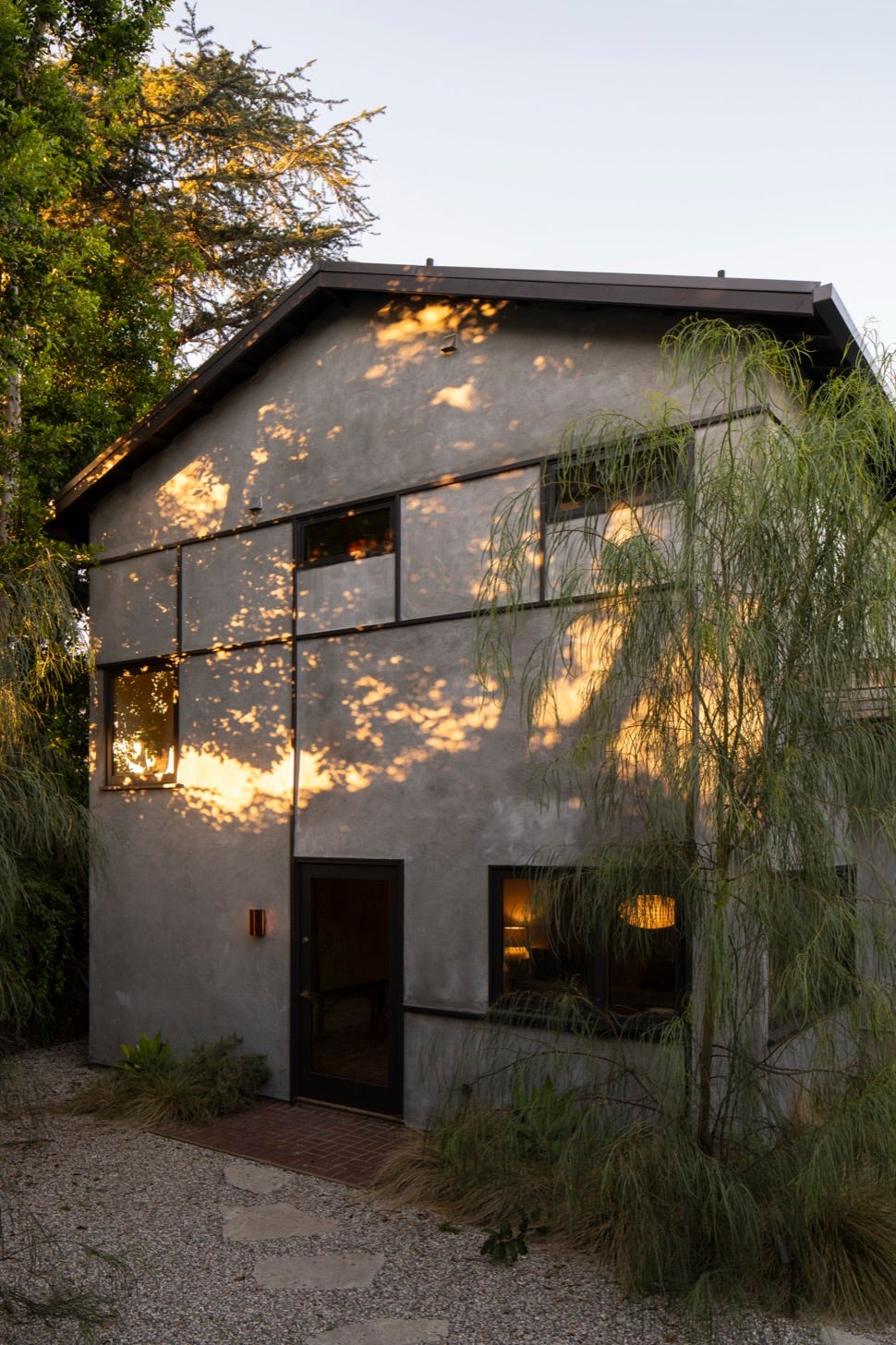
Ask Kathryn about the materials she’s proudest of, and she tells the story behind each one. The barn’s stucco, with its cedar trim detailing and Japanese-Swedish chalet sensibility, evolved during an on-site meeting where she and architect Linda Taalman stood in front of the facade under construction and decided it needed something more. Their stucco contractor, Felix, “probably thought we were a bit mad, but went along with it.” The pattern was later repeated on the ADU.
The hand-finished stucco on the ADU catches the morning light.
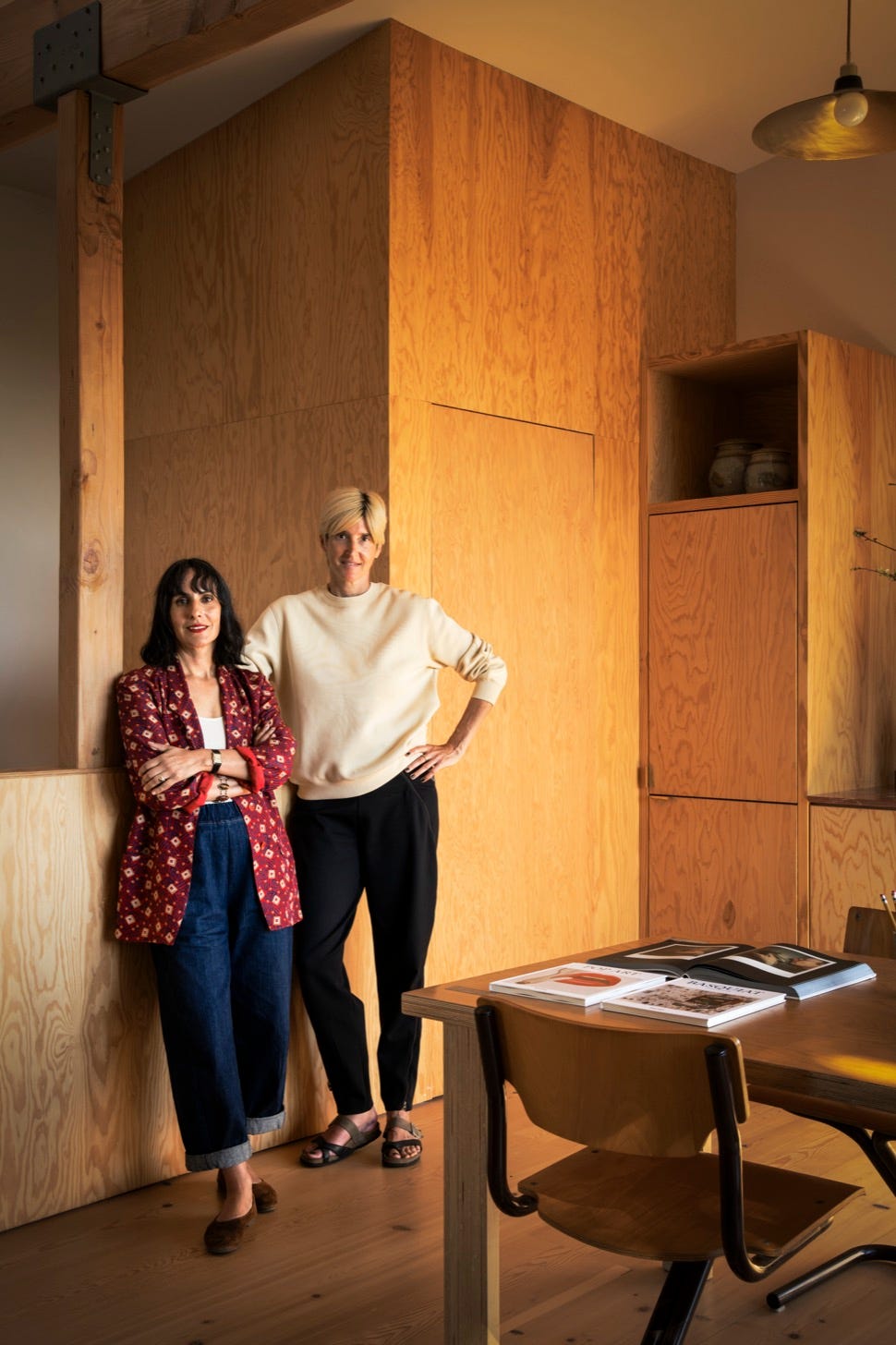
Kathryn McCullough and architect Linda Taalman in the ADU. The Douglas fir plywood wall panel system and built-in storage were developed collaboratively between the two studios.
Left: Douglas fir cabinetry and a wood-topped counter bathed in morning light, canopy views through the windows in the ADU. Right: The ADU living room with vaulted ceilings, a Commune chandelier, and a corner that opens to a view of DTLA in the distance.
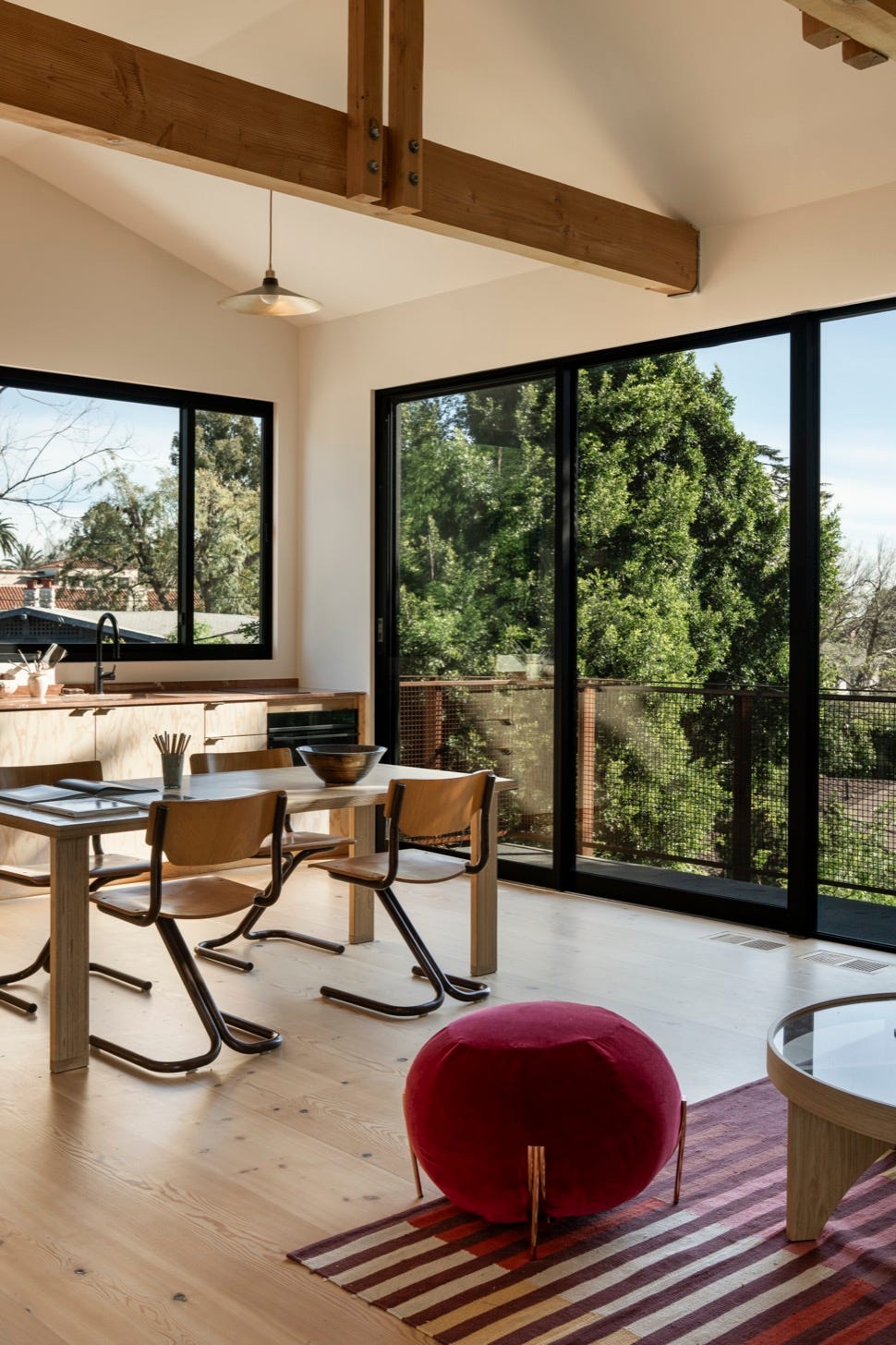
The ADU's main floor, where kitchen, dining, and living collapse into one light-filled room. Pine floors, exposed Douglas fir beams, and floor-to-ceiling sliding doors that put the Mount Washington canopy front and center.
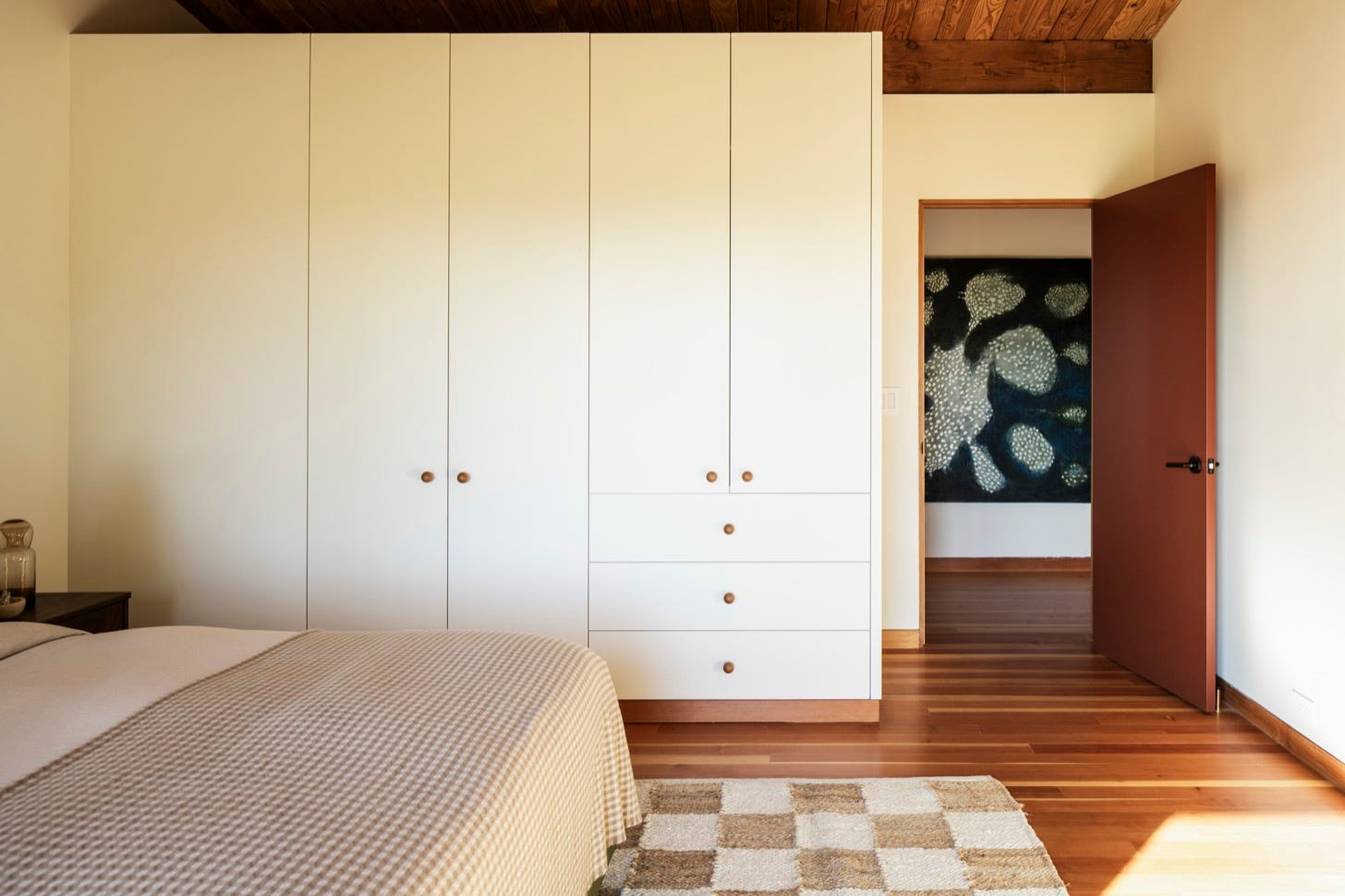
Built-in wardrobe with brass hardware in the primary bedroom and a glimpse of artwork through the open door. The property was always imagined for someone who lives with art throughout the space.
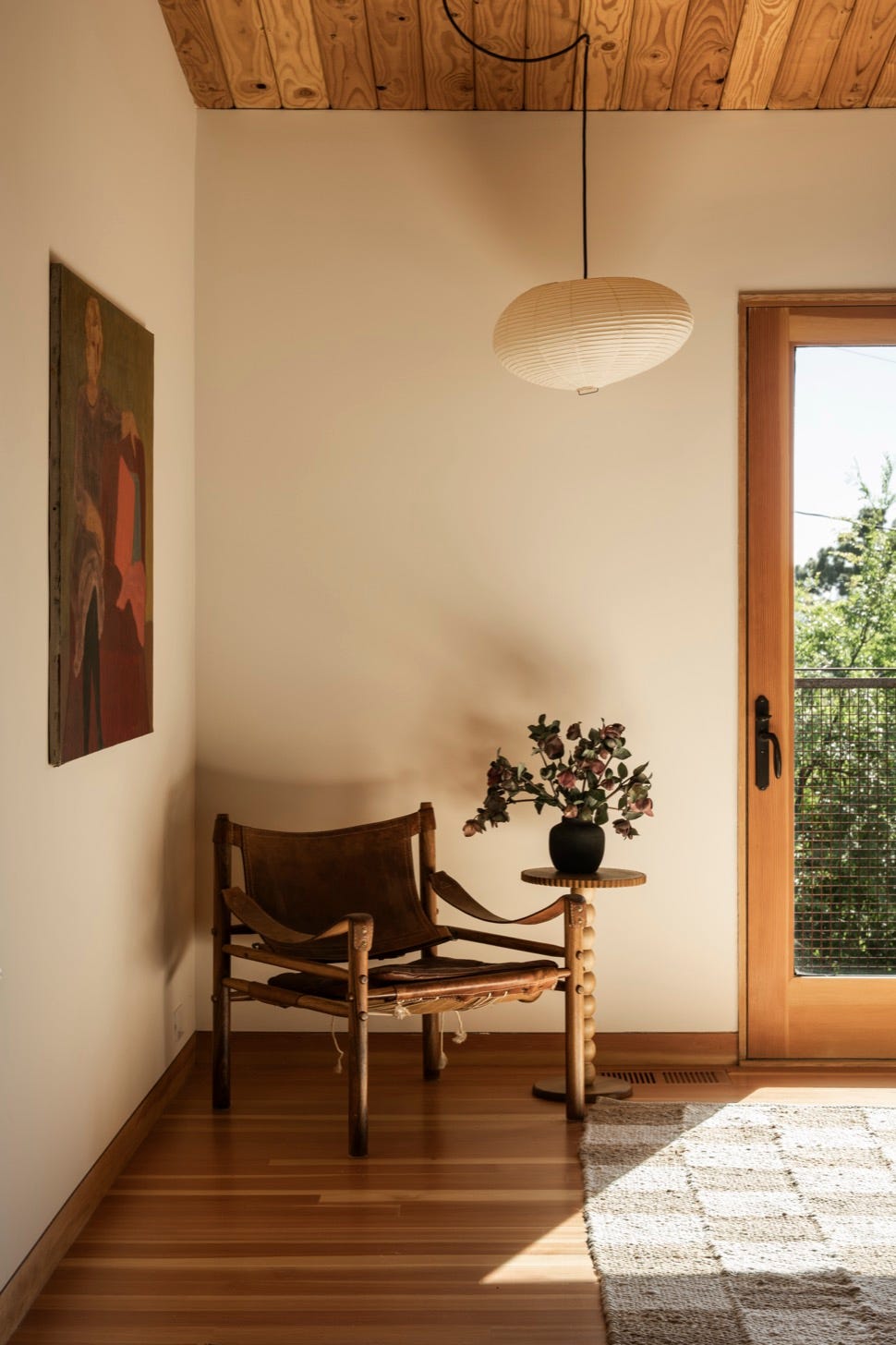
A quiet corner in the primary home anchored by a Noguchi lantern pendant and original artwork. TM Cobb Douglas fir-framed doors open to the hillside beyond.
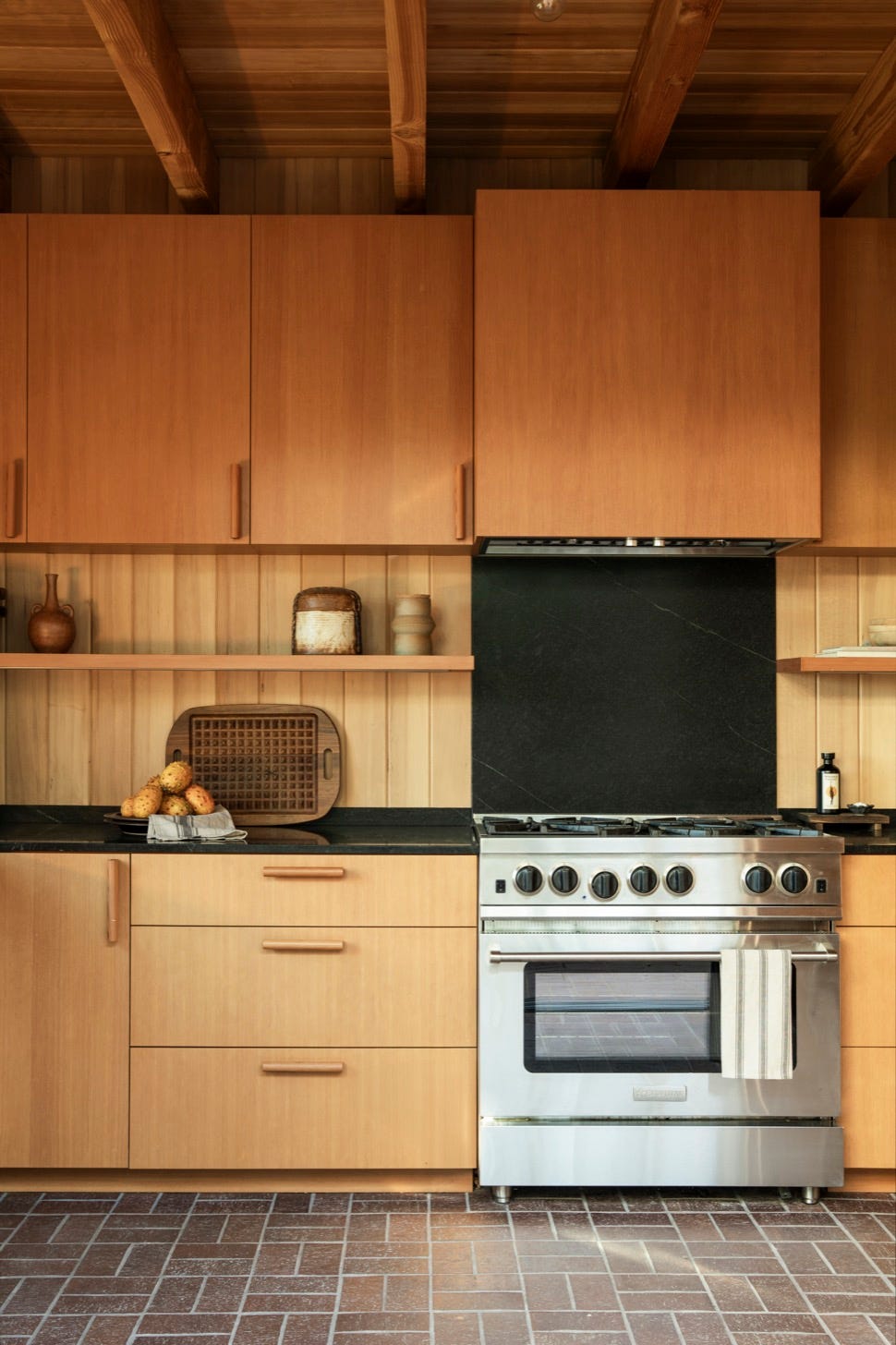
The primary home kitchen, designed by Neil Rasmussen of Estuary Home, features Douglas fir cabinetry running floor to ceiling, a honed black stone backsplash behind the range, and a handmade brick floor that continues through to the outdoor patio.
The brick kitchen floor nearly didn’t happen. “I almost chickened out,” Kathryn admits. It was Linda who gave her the push to hold the line. Now the brick flows from the kitchen directly onto the outdoor patio, blurring the boundary between inside and outside with quiet confidence.
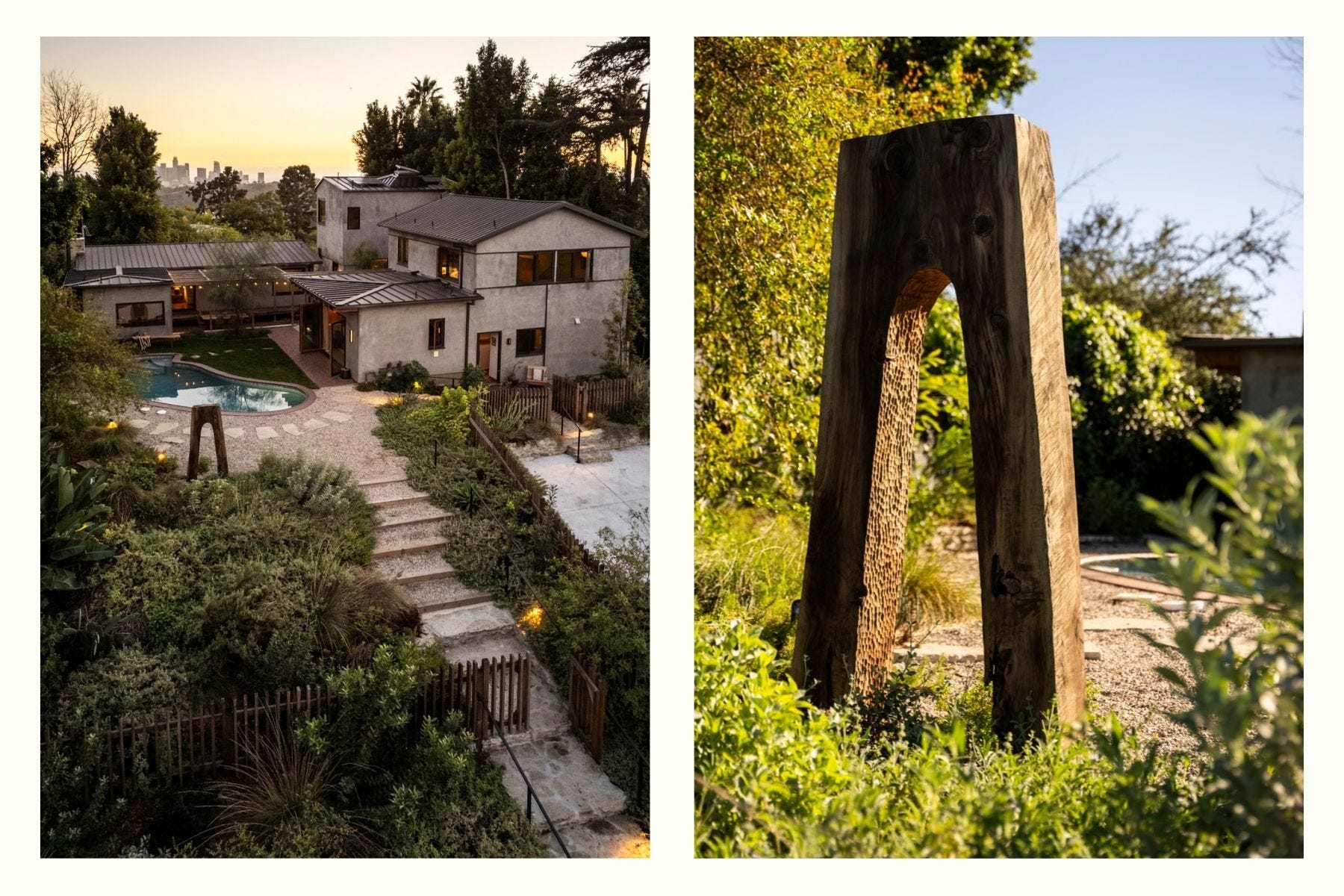
The primary home kitchen overlooks the pool and Vince Skelly sculpture, with the San Gabriels in the distance.
The fireplace mantel is the work of Vince Skelly, introduced to Kathryn through Terremoto. Skelly also made the sculpture in the garden. “The way the light washes the sculpture and the mantel is just stunning,” she says. The credit, she’s quick to note, goes to Andrew.
The hand-carved Vince Skelly mantel anchors the living room of the primary home.
Lighting throughout the property comes largely from Ravenhill Studio, helmed by Brendan Ravenhill, a longtime friend who Kathryn has watched grow his business from his living room to a full studio. The kitchen was designed by Neil Rasmussen of Estuary Home. Tiles are sourced from Clé, Heath, and Zia. Everything is handmade, tactile, considered.
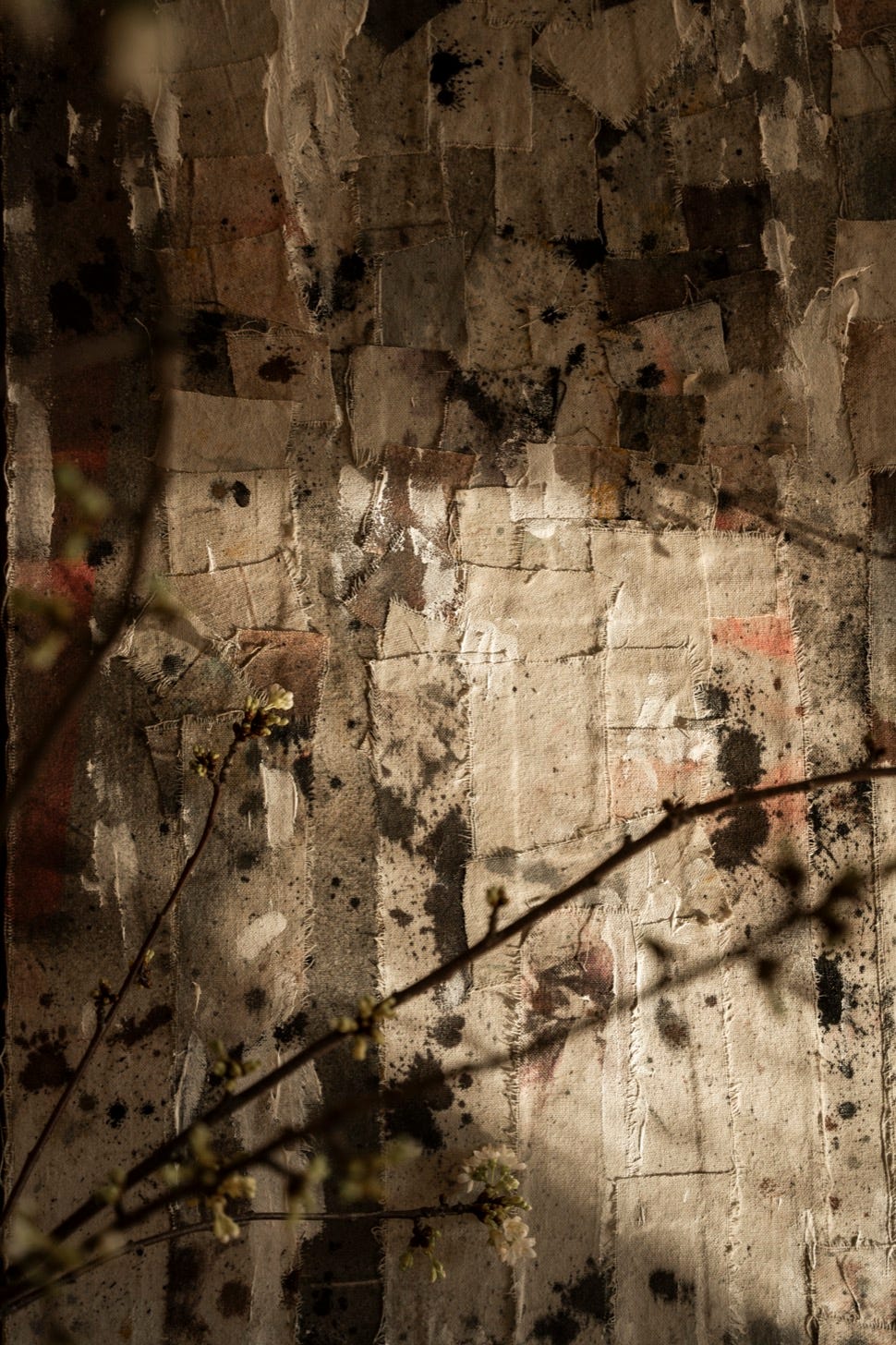
A close detail of one of the artworks staged throughout the property. Studio Souline's styling draws on handmade, hand-finished objects and textiles that share the same material sensibility as the architecture: materials that get more beautiful with age.
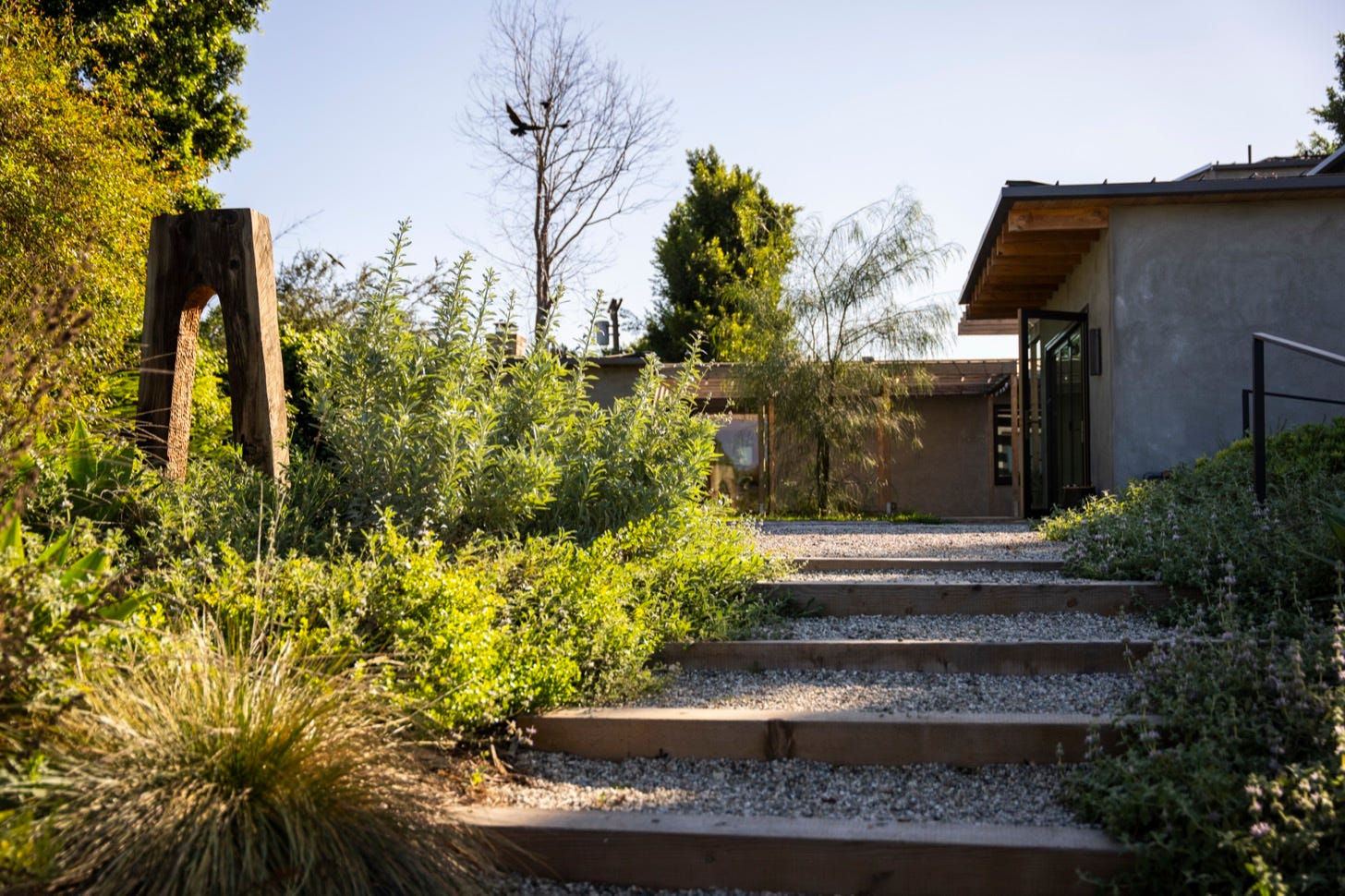
The path up to the compound from the street.
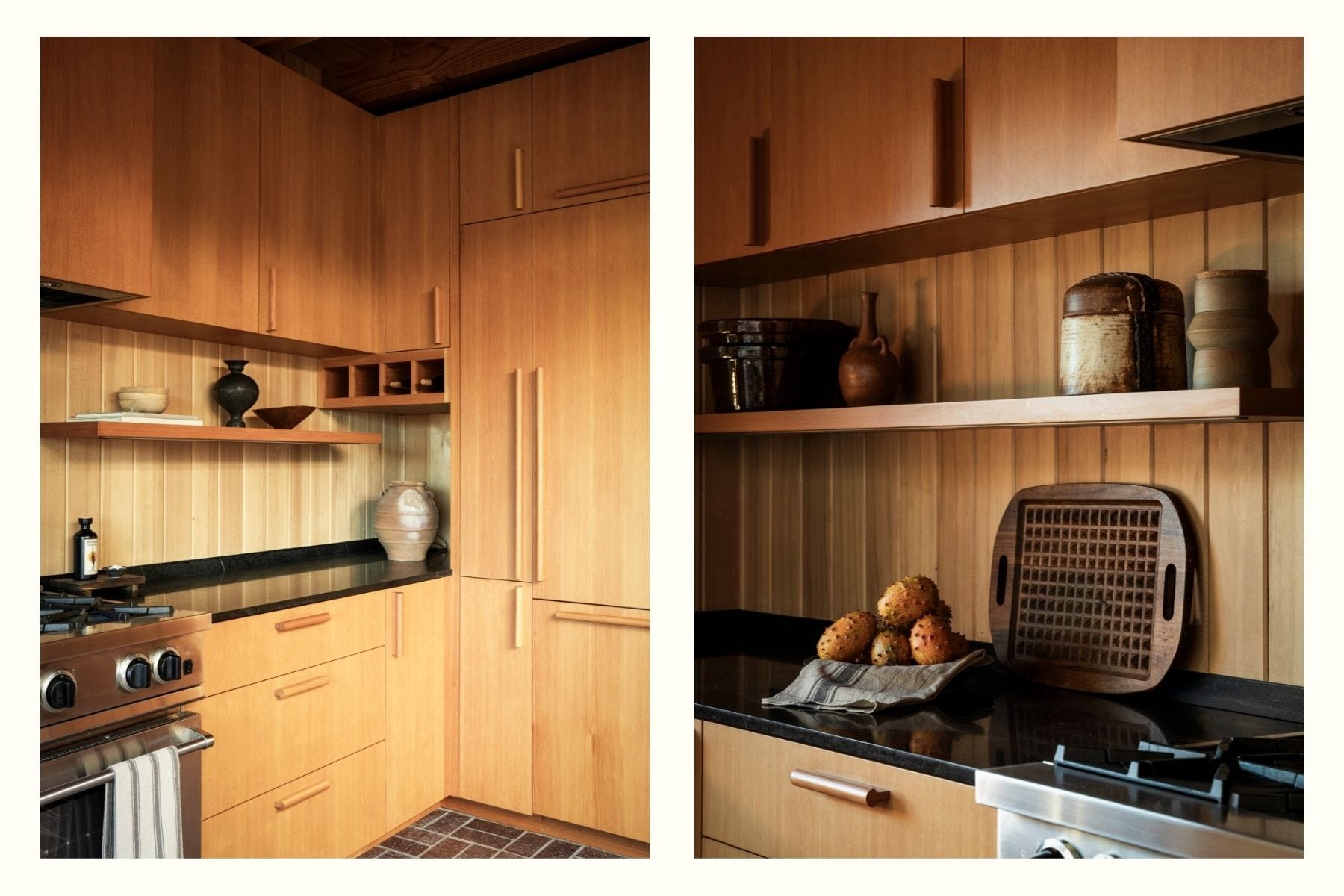
The barn kitchen, up close. Douglas fir cabinetry with hand-turned pulls, honed black stone countertops, open shelving styled with ceramics and earthenware. The refrigerator panel-matched to the cabinetry — seamless, almost invisible. Everything designed to be used.
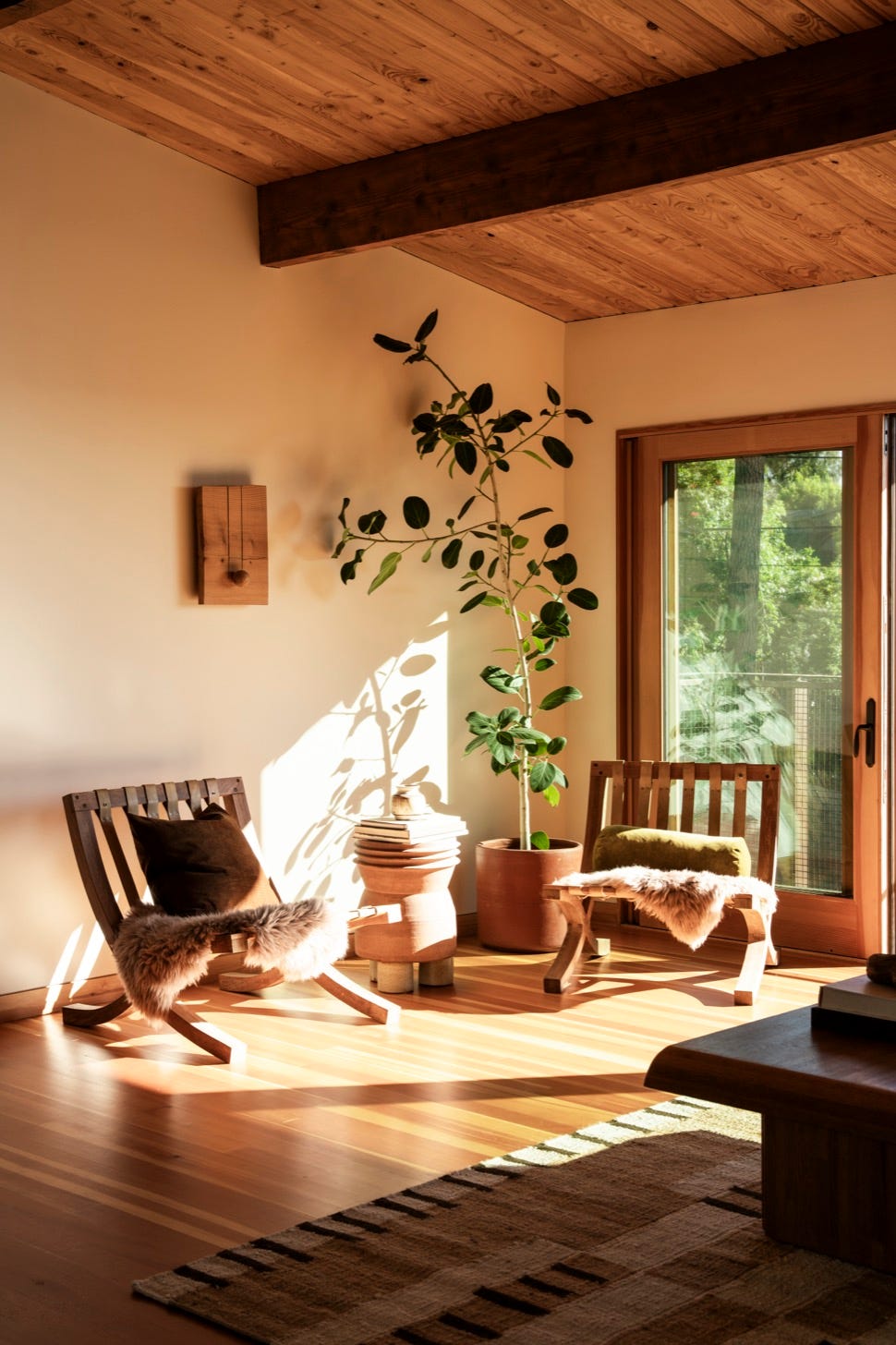
Late afternoon light floods the living room of the primary home, casting the ficus and the furniture into silhouette. Douglas fir ceiling boards, a Ravenhill Studio sconce, sheepskin throws on a pair of low slung chairs. The kind of corner that makes people stay.
Left: The compound at dusk, downtown LA visible on the horizon. Concrete broken during construction was reset as the pathways below. Right: Vince Skelly's garden sculpture — the same hand that carved the fireplace mantel — standing among Terremoto's native planting.
Kathryn came to Mount Washington the way many do — through a friend, at night, coming off the freeway and suddenly finding herself in the woods.
She’s clear about what drove her and Andrew to invest in the Rome property beyond the pure project: they didn’t want to watch a generic spec house go up in their neighborhood.
Mount Washington has a particular architectural legacy — Lautner, A. Quincy Jones and Whitney Smith, James DeLong, John Kemper Nomland — and a community that runs tighter than most Angelenos would expect. “Everyone knows everyone. Kids run around to one another’s houses. Everyone knows everyone else’s dogs,” she says. “It’s that kind of place that you wouldn’t expect in a big metropolitan city.”
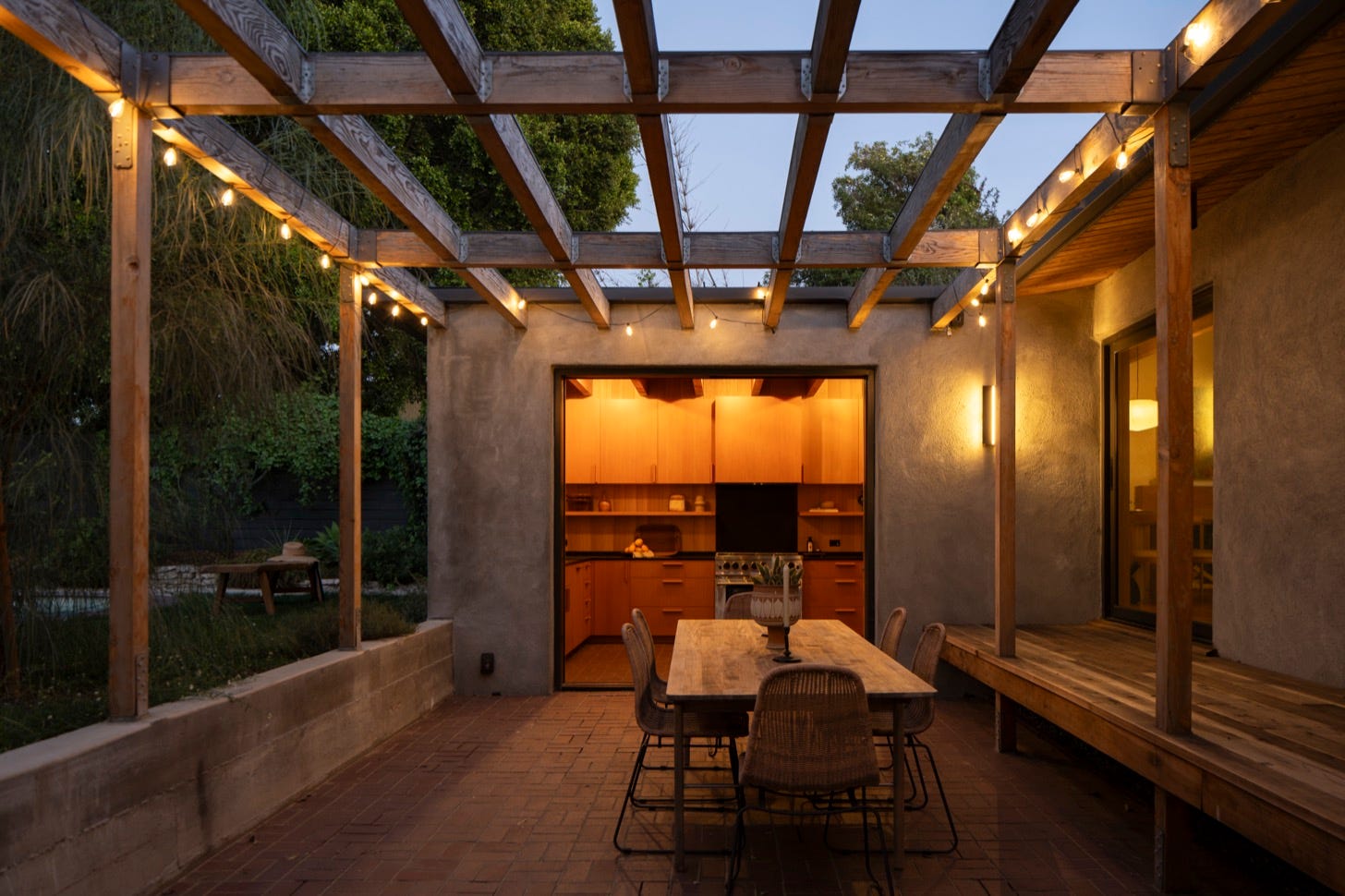
The primary home’s outdoor dining terrace at dusk — Douglas fir pergola overhead, brick patio underfoot, the kitchen framed like a lantern through the open bi-fold. The inside and outside of this property were always designed as one.
The pool house open to the garden at dusk, its Douglas fir interior glowing amber against the hand-finished stucco exterior. The courtyard, the pool, the pergola, the glow of the sunset on the sea to the west — this is what Kathryn means by the deep exhale.
The compound was always imagined for a particular kind of inhabitant — “a creative artist, producer, writer, musician type,” in Kathryn’s words. Someone for whom the wide view and the quiet and the owls in the night would register as the luxury they are.
“I think you know when a space is good when people who come over don’t want to leave. Like a warm hug.”
This interview has been edited and condensed for clarity and length.
THANK YOU FOR READING.
SANCTUARIES LA IS AN ONGOING PROJECT EXPLORING HOMES, MAKERS, AND SHARED SPACES ACROSS LOS ANGELES. YOU CAN EXPLORE THE FULL ARCHIVE TO SEE ALL STORIES TO DATE.
THIS PUBLICATION GROWS THROUGH WORD OF MOUTH. IF YOU ENJOYED THIS PIECE, CONSIDER SHARING IT WITH SOMEONE WHO MIGHT AS WELL.



All of the wood surfaces here are so dreamy.
I vist SRF hq’s on Mt Washington frequently
What a wonderful oasis in the sky!