


SANCTUARIES LA EXPLORES THE QUIETER SIDE OF LOS ANGELES THROUGH DESIGN.
ROOTED IN THE BELIEF THAT SANCTUARY EXISTS EVERYWHERE, OFTEN HIDDEN IN PLAIN SIGHT.
IF YOU ENJOY THIS PUBLICATION, CONSIDER SUBSCRIBING OR SHARING IT WITH A FRIEND.
I live on a half-acre lot on a hill at the edge of Highland Park and Eagle Rock, surrounded by coyotes. After seven years of run-ins — rooftop screaming sessions, our fifty-pound dog bursting out of our gate in chase, a standoff caught on my own security cameras — here's the field-tested guide I wish someone had handed me.
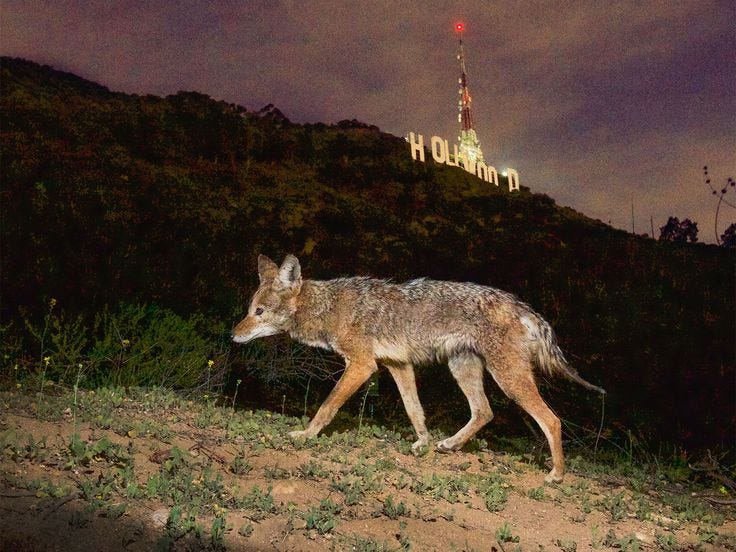
When I first moved to LA, I was enamored with the coyotes. They’re so cute. That one needs a mom. Look at them playing. Then I got my dog, Murphy. We’d run into them on trails, he’d freak and give chase, and overnight they went from charming to a source of stress. From quasi-cute to menacing.
I've had countless run-ins since. Hazed them until I looked like an actual psycho. Watched one stare me down with a dead house cat — collar still on — in its mouth. Spent weeks trying to get animal control on the phone for an injured one burrowed at my neighbor's fence line, to no avail. Stood on my roof at midnight, arms flailing, growl-yelling and stomping at the pack to get the fuck out of my backyard. Once, six months pregnant, I chased a collarless Murphy down the street after he shot out the gate at one, screaming for anyone to help me catch him; my neighbor's contractor, up at the top of the hill, was the one who did.
It runs in cycles — months of nothing, then months of them everywhere. We’ve tried it all: reinforced the fence, sprayed wolf pee around the perimeter, got the whole street to spray wolf pee. There’s a neighbor group chat that exists mostly to live-update sightings so everyone can pull their pets and kids inside.
Two weeks ago I let Murph out for his normal morning pee and heard an unfamiliar yip cut through his bark. My neighbor, Andrei, shouted. I ran out to find my dog in a standoff with a lone coyote that wouldn’t back down. The exterior cameras caught the rest; the coyote went after my dog twice. Murph somehow got away bite-free.
So here's a practical guide for dealing with coyotes — because the people I watch stare in dumb awe instead of hazing clearly don't know how to handle this, and here in the hills of Northeast LA, you have to.
A FIELD NOTE ON THE SONG DOG
Here’s what helped me most: actually learning about our coyote neighbors.
That “unfamiliar yip chorus” I hear at all hours of the night? It probably isn’t a pack. A bonded pair yipping and howling together throws an auditory illusion — researchers call it the beau geste effect — that makes two animals sound like a dozen. The howling isn’t a hunt. It’s a family talking across the landscape, marking the edges of home. Suddenly that takes it from sinister to … a little sweet?
Because they do live in families. Coyotes are monogamous, often for life — urban ones especially, with some studies clocking near-total fidelity. The unit is a mated pair and their young, and that pair defends its territory against other coyotes, which is its own quiet form of population control: a held territory keeps the area from filling up. It’s also why removal backfires.
They earn their keep. A single coyote can eat well over a thousand rodents a year. And in LA specifically, the Natural History Museum’s research found the thing most people get backwards — domestic cats are nearly absent from the coyote-rich interior of Griffith Park, but everywhere in the more fragmented hills without them. Strip the coyotes out and you don’t get a calmer ecosystem; you get more feral cats and smaller predators, and more pressure on the songbirds and reptiles underneath. The predator on your fence line is, inconveniently, a sign the block is still alive.
And they are almost never the danger they’re cast as. In all of recorded history there are two confirmed fatal coyote attacks — set that against the thousands of dog bites LA logs every year. The fear is real; the statistics aren’t on its side.
They were here first — the native song dog, in these hills since the Ice Age, long before the lots were drawn. This was a sanctuary before it was an address. It still is — we just don’t have it to ourselves. So the work isn’t getting rid of them; it’s learning to live alongside them — which, it turns out, comes down to a handful of things.
1. BE A BORING BLOCK
Here’s the thing: the coyote isn’t the problem. The block is. Justin Brown, the National Park Service biologist who runs the L.A. Urban Coyote Project, has heard every version of the panic — the one sleeping in someone’s yard, the one trailing a dog down the street. His read is unsentimental. When there’s conflict, he told LAist, “they’re coming into your neighborhood for a reason.” Some resource they keep finding.
Coyotes are opportunists, and LA sets a long table. The single biggest driver is the one we planted ourselves — ornamental fruit trees, the kind shading half the streets on the Eastside, dropping figs and loquats and dates onto the sidewalk all summer. Brown’s scat research found that human-linked food — garbage, that fallen ornamental fruit, the occasional cat — made up 60 to 75 percent of an urban coyote’s diet. So pick the fruit up. Pet bowls off the porch, trash latched, bird seed gone, compost closed. And never, ever feed one on purpose. That’s the line that ends badly for everyone.
It’s not just food. In a dry city, water is its own draw — and they’ll work for it. We’ve come out to find our garden’s drip system chewed apart, emitters torn off the line, the coyotes having figured out the irrigation before we did. Walk your system. Patch the leaks, cap what’s weeping, and don’t leave standing water sitting out — bowls, saucers under pots, a forgotten bucket. A reliable drink is a reason to keep coming back.
And the wolf pee — yes, we’ve tried it, the whole street has tried it. Predator-urine deterrents are worth a shot and easy enough to run around the perimeter, but be aware: they wash off in a sprinkle, need constant reapplying, and a hungry coyote that’s already comfortable on your block will walk right past it. Treat it as a small nudge, not a fence. The fruit and the water are the fence.
2. MAKE YOURSELF UNFORGETTABLE
If one holds its ground, don't run — running makes you prey. Stand tall, wave your arms, get loud. Yell, an air horn, a coffee can full of coins. Walk toward it, never corner it, until it leaves for good. Halfway counts for nothing. Quit early and all you've taught it is that humans make noise and then go away. And it takes the whole street: "Hazing is a community effort," Citizens for L.A. Wildlife puts it plainly. One brave neighbor and an easygoing rest of the block, and the coyote does the math.
Hence the hazing to the point of looking psychotic situation. Whenever I do this, both the coyotes and the local people look at me like I’m insane.
3. KNOW THE SEASON
Spring through late summer is pup season. A coyote shadowing you at a distance — especially if you've got a big dog — is usually walking you away from a den, not hunting you. Move steady, don't turn your back, keep going. "This is their territory, and they protect their territory," Calabasas environmental manager Alex Farassati told NBC. Read it as a parent, not a predator.
This explains why we don’t see them for months, and suddenly it feels like they’re everywhere. We are spotting them mostly during pup season and drought season when they are looking for water in our yards.
4. PROTECT YOUR PETS
Keep cats indoors. I have a senior cat, Tony, who still likes his daytime sun — I only let him out after Murphy’s swept the yard, and even then I keep eyes on him. We put baby gates on the porch for a little indoor-outdoor compromise.
Small dogs go on a six-foot leash — flat, not retractable. Don’t leave anyone out unsupervised, fence or no fence. If a coyote comes close on a walk, pick your little one up.
5. DON’T CALL A TRAPPER
It never occurred to me to try, but apparently it's the first instinct for a lot of people — and the wrong one. In LA, trapping and relocating is illegal: by state law a trapped coyote is released on the spot or killed. "Humane relocation" is a myth — an animal dropped in unfamiliar territory rarely survives. And it doesn't even work. Pull the resident pair off a block and you open a vacuum — the territory clears, a new coyote moves in, and with the pressure gone the pack often breeds larger. The city's whole policy is coexistence for exactly this reason. A boring block is the only thing that actually holds.
6. RALLY YOUR NEIGHBORS
None of this is a solo sport. The single most useful tool we have isn't the air horn or the wolf pee — it's the neighbor group chat. Live sightings, so everyone pulls pets and kids in at the same time. Shared hazing, so the whole hill reads as hostile instead of one lone weirdo on a roof. If your street doesn't have one, start it. It's the cheapest coyote deterrent there is.
So: clear the table, read the season, keep your animals close. And when one stares you down at dawn, don't gawk. Get big, get loud, and remember it has more claim to the hill than you do. Then go inside and text the group chat.